


Healthiest Countries in the World: Global Ranking for 2026

- What does “healthiest country” actually mean?
- Data sources and methodology
- Top 10 healthiest countries in the world in 2026
- Why these countries rank so highly
- Healthiest countries by alternative measures
- Limitations of any “healthiest country” ranking
- Healthiest Countries by Region
- Least Healthy Countries in the World
- Key Factors of Healthy Countries: What Makes a Country Healthy?
The healthiest countries in the world in 2026 are not simply the ones that spend the most on healthcare. The leaders tend to combine long life expectancy, strong healthy life expectancy (HALE), broad access to essential services, low preventable and treatable mortality, and healthier everyday risk factors. WHO (World Health Organization) and the World Bank publish component indicators such as HALE, life expectancy, and universal health coverage rather than a single official “healthiest countries” leaderboard, so the ranking below is an editorial synthesis of the latest comparable WHO, World Bank, OECD, and air-quality data.
What does “healthiest country” actually mean?
A healthy country is one that helps people live long lives and keeps more of those years healthy. WHO defines healthy life expectancy as the average number of years a person can expect to live in full health, not merely the number of years lived overall. WHO and the World Bank also track UHC service coverage, which combines 14 tracer indicators across maternal and child health, infectious disease, noncommunicable disease, and service capacity and access.
That is why this list does not depend on one metric alone. A country can look excellent on longevity but less impressive on prevention, or spend heavily on medicine without translating that spending into better population health. The best performers are the countries that keep appearing near the top across life expectancy, HALE, access to care, avoidable mortality, and key risk factors.
Data sources and methodology
This ranking focuses on sovereign countries with broad, comparable data coverage. It gives the most weight to life expectancy, healthy life expectancy, healthcare access, and avoidable mortality, then uses risk factors such as obesity, smoking, physical inactivity, and air pollution as tie-breakers. OECD explicitly describes avoidable mortality as a useful starting point for assessing how well public-health and healthcare systems reduce premature deaths.
Microstates and special cases deserve a note. If you sort only by life expectancy, places such as Monaco, San Marino, Hong Kong, and Andorra rise to the very top of global tables. They are real outliers, but they are harder to compare with larger national systems, so they are not the core focus of this article.
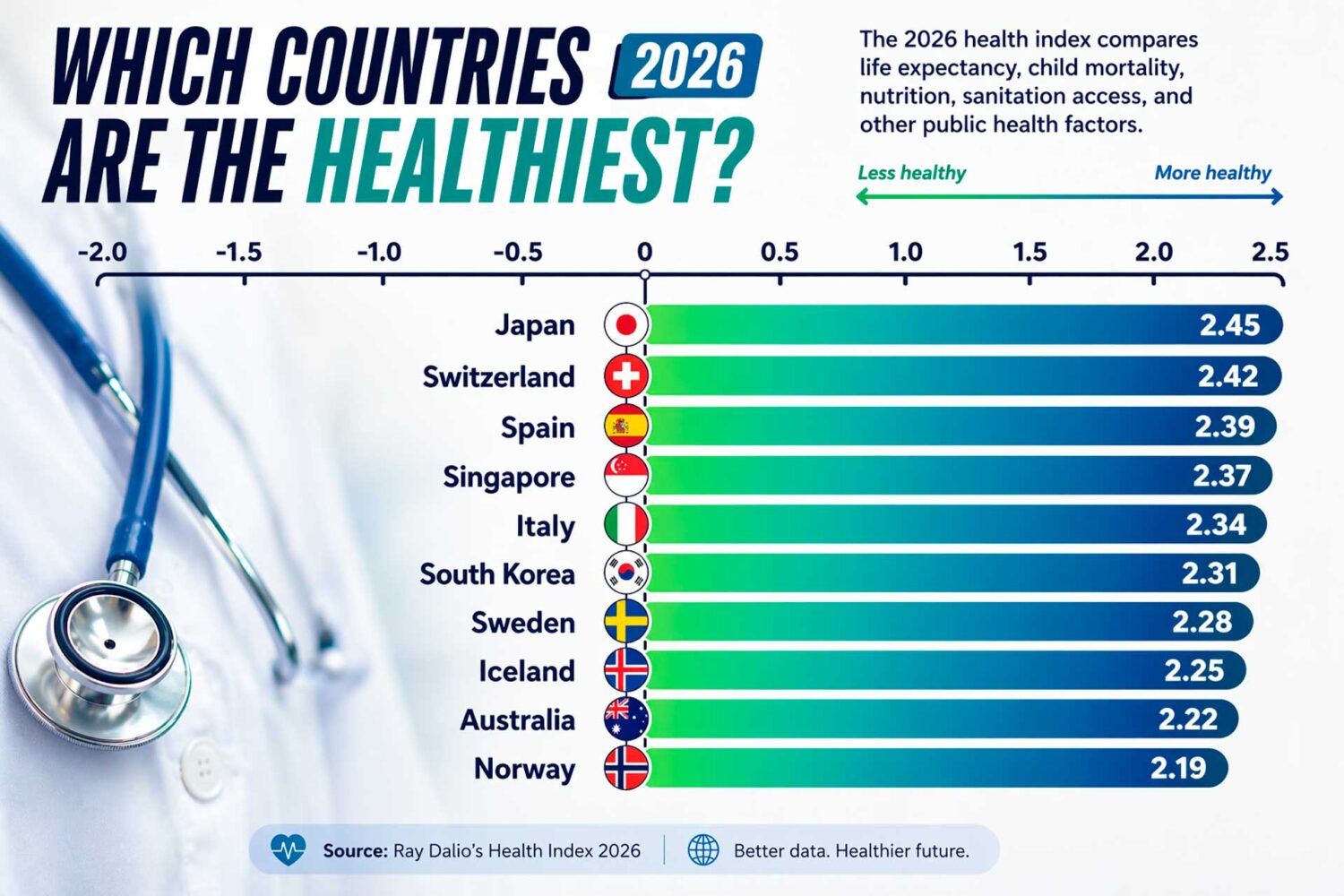
Top 10 healthiest countries in the world in 2026
In 2026, the top 10 healthiest countries are defined not only by how long people live, but by how effectively nations support healthy living through healthcare access, prevention, and lifestyle factors.
1. Japan
Japan remains the global benchmark for healthy ageing. OECD’s 2025 country note puts Japanese life expectancy at 84.1 years, around three years above the OECD average, while preventable mortality is 86 per 100,000 and treatable mortality 49 per 100,000, both clearly below OECD norms. OECD also reports that, alongside Korea, Japan is one of the few OECD countries where less than 40% of adults are overweight or obese in measured data.
Japan also benefits from deep institutional strength. WHO’s country profile reports health expenditure at 10.82% of GDP in 2021 and tracks both life expectancy and HALE as core national indicators. Put simply, Japan does not just help people live longer; it helps more people stay healthier into old age than most countries manage.
2. Switzerland
Switzerland combines excellent longevity with exceptional system performance. The World Bank still rounds Swiss life expectancy to 84 years in its latest data, and OECD identifies Switzerland as one of the countries with fewer than 140 avoidable deaths per 100,000 population. It is also among the best performers on preventable mortality and one of the three strongest countries on treatable mortality, alongside Luxembourg and Korea.
The quality-of-care side is just as impressive. OECD reports that Switzerland performs above average on 6 of 10 access and quality indicators, covers the whole population for a core set of services, and has very high satisfaction with healthcare availability at 89%. Switzerland also has lower obesity than the OECD average and lower PM2.5 exposure than the OECD average.
3. Spain
Spain earns a top-three place because its results are consistently strong. OECD puts Spanish life expectancy at 84 years, 2.9 years above the OECD average, with preventable mortality at 92 per 100,000 and treatable mortality at 50 per 100,000. World Bank data also still round Spain to 84 years in 2024, keeping it firmly in the global longevity elite.
Spain also benefits from a lifestyle pattern that health authorities have long viewed favorably. The American Heart Association describes the Mediterranean diet as a pattern centered on vegetables, legumes, whole grains, olive oil, fish, and minimally processed foods, and UNESCO lists Spain among the countries formally associated with the Mediterranean diet tradition. Diet is not the entire explanation, but it clearly reinforces an already effective health system.
4. Singapore
Singapore is one of the clearest examples of health-system efficiency. The World Bank’s latest data still put life expectancy at 83 years, while WHO’s country profile tracks both life expectancy and healthy life expectancy and reports current health expenditure at 5.57% of GDP in 2021. That is a much lower spending share than Switzerland or Japan, yet the outcome remains world-class.
That mix of long life expectancy and comparatively modest spending is exactly why Singapore keeps appearing in serious healthiest-country discussions. It is one of the few places that combines elite outcomes with a visibly efficient spending profile.
5. Italy
Italy is often overshadowed by Spain in health rankings, but the gap is small. OECD reports Italian life expectancy at 83.5 years, preventable mortality at 93 per 100,000, treatable mortality at 52 per 100,000, and suicide at just 6 per 100,000, well below the OECD average. Self-reported obesity in Italy is also lower than the OECD average.
Italy’s health system matters too. OECD says the entire population is covered for a core set of services, unmet healthcare needs are below the OECD average, avoidable admissions are far lower than the OECD average, and 30-day mortality after heart attack is also below the OECD norm. Like Spain, Italy pairs strong institutions with Mediterranean eating traditions, which helps explain why it continues to outperform many richer countries on longevity.
6. South Korea
South Korea has moved from fast improver to global leader. The World Bank rounds Korean life expectancy to 84 years in 2024, and OECD puts Korean life expectancy at 83.5 years with treatable mortality at just 45 per 100,000, one of the best readings in the OECD. Self-reported obesity is only 5%, far below the OECD average.
Korea is especially strong on the treatment side of healthcare. OECD reports full population coverage for a core set of services, high childhood vaccination, strong breast-cancer screening, and avoidable admissions below the OECD average. Its profile is not perfect, but its balance of longevity, low obesity, and strong treatment outcomes is hard to match.
7. Sweden
Sweden stands out because it is not just healthy on outcomes; it is healthy on system design. The World Bank still rounds Swedish life expectancy to 84 years, and OECD says Sweden performs better than the OECD average on all 10 access and quality indicators in its 2025 country note. That is one of the strongest all-round showings in the dataset.
Sweden’s risk-factor profile is also unusually favorable. OECD reports very low smoking, low physical inactivity, and PM2.5 exposure of 5.6 micrograms per cubic metre, roughly half the OECD average. Public satisfaction with healthcare is above average, and outcomes after heart attack and stroke are notably strong.
8. Iceland
Iceland is a smaller country, but its health performance is broad-based rather than narrow. OECD says Iceland performs better than the OECD average on 9 of 10 indicators measuring health status and risk factors. Life expectancy is 82.4 years, preventable mortality 101 per 100,000, and treatable mortality 49 per 100,000, all stronger than OECD averages.
Environmental conditions help too. IQAir’s 2025 World Air Quality Report says Iceland was one of the countries or territories that met the WHO annual PM2.5 guideline in 2025, which is increasingly rare globally. Iceland therefore combines good healthcare results with a cleaner environmental backdrop than most countries can offer.
9. Australia
Australia remains a top-tier health performer even though it is not flawless. OECD reports life expectancy at 83 years, preventable mortality at 99 per 100,000, and treatable mortality at 47 per 100,000, all better than OECD averages. The World Bank also continues to round Australian life expectancy to 83 years.
Australia’s risk profile is mixed. Smoking is low and PM2.5 exposure is better than the OECD average, but obesity is higher than the OECD average. That is why Australia belongs in the top 10 but not higher: it pairs strong healthcare outcomes with a weaker metabolic-risk profile than Japan, Korea, or Switzerland.
10. Norway
Norway earns a place in the top tier because it combines high life expectancy with strong system capacity. OECD puts Norwegian life expectancy at 83.1 years, above the OECD average, and WHO reports current health expenditure at 9.92% of GDP in 2021. Norway does not have the same standout mortality detail available in the OECD note as some peers, but its overall profile remains that of a high-performing, high-capacity health system.
This last slot is the most debatable in the ranking. On narrower metrics, countries such as Luxembourg or Israel could make a strong claim, but Norway remains a defensible top-10 choice because of its consistency on longevity, spending capacity, and broad institutional strength.
If you’re considering relocating to one of the world’s healthiest countries, it’s worth evaluating your options with expert guidance. Request a consultation to explore the best immigration pathways tailored to your goals and start planning your move with confidence.
Schedule a free consultation and get detailed information from Unioncitizenship lawyers. Start the process today!

Why these countries rank so highly
Three patterns appear again and again.
- First, the healthiest countries tend to keep both preventable and treatable mortality low. OECD’s 2025 data highlight Switzerland, Luxembourg, and Israel on preventable mortality; Switzerland, Luxembourg, and Korea on treatable mortality; and Japan, Israel, Sweden, Luxembourg, and Switzerland on overall avoidable mortality. In other words, the best countries do not merely treat disease well; they prevent more deaths from happening in the first place.
- Second, they usually have healthier risk-factor patterns. OECD reports that Japan and Korea remain clear low-obesity outliers among rich countries, Sweden combines low smoking with very low physical inactivity and cleaner air, and Switzerland also sits below average on obesity and PM2.5 exposure. Population health is not created in hospitals alone; it is reinforced by food environments, movement, cleaner air, and prevention.
- Third, many of them combine universal or near-universal access with relatively strong trust or satisfaction. Switzerland, Sweden, Italy, Australia, Korea, and Luxembourg all report full population coverage for a core set of services in OECD’s country notes, while WHO and the World Bank use service-coverage indicators to track broader UHC progress internationally.
Healthiest countries by alternative measures
If you rank countries only by life expectancy, the leaderboard changes. Monaco, San Marino, Hong Kong, Japan, South Korea, Andorra, Switzerland, Australia, Italy, and Singapore all appear near the top of recent global longevity tables. That is why some lists look different from this one: they are really longevity lists, not full health-system or lifestyle rankings.
If you focus more on healthcare-system performance, Switzerland, Luxembourg, Korea, Japan, and Sweden look especially strong because of low avoidable or treatable mortality and good access metrics. If you focus more on environmental health, countries such as Iceland, Australia, Estonia, and Andorra gain ground because they met the WHO PM2.5 guideline in IQAir’s 2025 report.
Limitations of any “healthiest country” ranking
Every ranking has trade-offs. WHO explicitly notes that no single index can fully capture all the health services included in universal health coverage, and its UHC Service Coverage Index is built from a selected basket of 14 tracers rather than everything a health system does. The same limitation applies to broader health rankings: life expectancy, HALE, risk factors, and system performance each show something important, but none tells the whole story alone.
Data lag is another issue. Internationally comparable health numbers are usually published with a delay of several years, so the best 2026 article is always partly retrospective. Small states and territories can also dominate pure longevity tables, while larger countries may look stronger on system depth, prevention, or equity. That is why the ranking above should be read as a practical synthesis, not a mathematically final truth.
Healthiest Countries by Region
Health standards vary significantly across regions due to differences in healthcare systems, economic development, culture, and public policy.
- Europe. Europe is home to many of the world’s healthiest countries, including Spain, Switzerland, Italy, and Sweden. These nations benefit from universal healthcare systems, strong public health policies, and relatively healthy diets. European countries also tend to perform well in life expectancy and healthcare access.
- Asia. Asia features some of the global leaders in health, particularly Japan, South Korea, and Singapore. These countries stand out for their long life expectancy, low obesity rates, and efficient healthcare systems. Traditional diets and strong preventive care also contribute to their high rankings.
- Americas. Health outcomes in the Americas vary widely. Countries like Canada and Costa Rica perform relatively well due to accessible healthcare and strong public health initiatives. However, many countries in the region face challenges such as higher obesity rates, inequality in healthcare access, and lifestyle-related diseases.
- Middle East. The Middle East shows mixed health outcomes. Countries like Israel and the United Arab Emirates have advanced healthcare systems and improving life expectancy. However, the region also faces challenges such as high rates of obesity, diabetes, and sedentary lifestyles, which impact overall health rankings.
Least Healthy Countries in the World
While some countries consistently rank at the top, others face significant health challenges due to a combination of economic, environmental, and healthcare-related factors.
Countries with lower health outcomes often struggle with limited access to healthcare, higher rates of infectious diseases, malnutrition, and inadequate public health infrastructure. In some regions, political instability and poverty further limit access to essential services.
Additionally, rapid urbanization and lifestyle changes have contributed to rising rates of obesity, diabetes, and cardiovascular diseases in certain developing countries. Poor air quality and lack of clean water also remain major health risks in some parts of the world.
The following countries are often ranked among TOP 10 the least healthy globally based on life expectancy, disease burden, and healthcare access:
| Country | Life Expectancy (approx.) | Key Health Challenges | Region |
|---|---|---|---|
| Lesotho | ~53 years | HIV/AIDS, limited healthcare access | Sub-Saharan Africa |
| Central African Republic | ~54 years | Conflict, poor infrastructure, infections | Sub-Saharan Africa |
| Chad | ~55 years | Malnutrition, infectious diseases | Sub-Saharan Africa |
| Nigeria | ~54–55 years | High disease burden, healthcare inequality | Sub-Saharan Africa |
| Sierra Leone | ~55–57 years | Maternal & child mortality | Sub-Saharan Africa |
| Somalia | ~56–58 years | Weak healthcare system, instability | Sub-Saharan Africa |
| DR Congo | ~60 years | Epidemics, low healthcare access | Sub-Saharan Africa |
| India | ~67 years | Air pollution, population health disparities | South Asia |
| Pakistan | ~66–67 years | Pollution, infectious diseases | South Asia |
| United States | ~77–79 years | Obesity, chronic diseases | North America |
It is important to note that “least healthy” does not mean lacking progress. Many countries are actively improving healthcare access, investing in infrastructure, and implementing public health initiatives aimed at increasing life expectancy and overall well-being.
If you’re exploring better living conditions and healthcare systems abroad, choosing the right country and immigration strategy is key. Leave a request for a consultation to find the most suitable destination and pathway for your relocation.
Schedule a free consultation and get detailed information from Unioncitizenship lawyers. Start the process today!

Key Factors of Healthy Countries: What Makes a Country Healthy?
The healthiest countries in the world share several core characteristics that go beyond strong healthcare systems. These nations create environments where people can live longer, healthier lives through a combination of policy, culture, and infrastructure.
- Diet & Nutrition. A balanced and nutrient-rich diet is one of the most important contributors to national health. Countries like Spain, Italy, and Japan benefit from traditional diets rich in vegetables, whole grains, healthy fats, and lean proteins. Lower consumption of ultra-processed foods and added sugars is strongly linked to lower obesity rates and reduced risk of chronic diseases.
- Healthcare System. Access to affordable, high-quality healthcare is essential. The healthiest countries typically offer universal or near-universal healthcare coverage, ensuring that people receive preventive care, early diagnosis, and effective treatment. Strong primary care systems and public health programs also play a major role in improving population health outcomes.
- Lifestyle & Physical Activity. Daily habits matter. In many of the world’s healthiest countries, physical activity is naturally integrated into everyday life—through walking, cycling, and active commuting. Lower levels of sedentary behavior, combined with cultural norms around movement, contribute to better cardiovascular health and overall well-being.
- Environment & Air Quality. Clean air, safe drinking water, and low pollution levels significantly impact health. Countries with stricter environmental regulations and lower levels of industrial pollution tend to report fewer respiratory and cardiovascular diseases. Access to green spaces also supports both physical and mental health.
- Mental Health. Mental well-being is increasingly recognized as a key pillar of overall health. The healthiest countries invest in mental health services, reduce stigma around seeking help, and promote work-life balance. Social support systems, community engagement, and lower stress levels all contribute to healthier populations.
The healthiest countries in the world in 2026 are the countries that consistently turn healthcare access, prevention, and everyday lifestyle into long and relatively healthy lives. Japan, Switzerland, Spain, Singapore, Italy, South Korea, Sweden, Iceland, Australia, and Norway all follow slightly different models, but they converge on the same result: fewer preventable deaths, longer lives, and healthier ageing.
If you’re thinking about moving to one of these countries to improve your quality of life, it’s important to choose the right immigration pathway from the start. Leave a request for a consultation to get personalized guidance and explore your options for relocating to one of the world’s healthiest countries.




Find out details about obtaining an EU passport at a free consultation
Fill out a simple form and an immigration lawyer will contact you shortly.