


Countries With Birthright Citizenship in 2026
- Types of Birthright Citizenship
- Countries With Birthright Citizenship
- Major legal changes since 2015
- What the practical process looks like
- Processing time
- Costs and fees
- Renewal, extension and pathways if a child is not a citizen at birth
- Why birthright citizenship claims are denied
- Common misconceptions
- Expert tips for getting the law right
- Real-case examples that matter
Birthright citizenship is the legal acquisition of citizenship through birth. That can happen because a child is born in a country under a jus soli rule, because the child is born to a citizen parent under a jus sanguinis rule, or because both principles operate together in a mixed system. GLOBALCIT’s 2025 report emphasizes that most countries combine these principles in some way rather than applying only one.
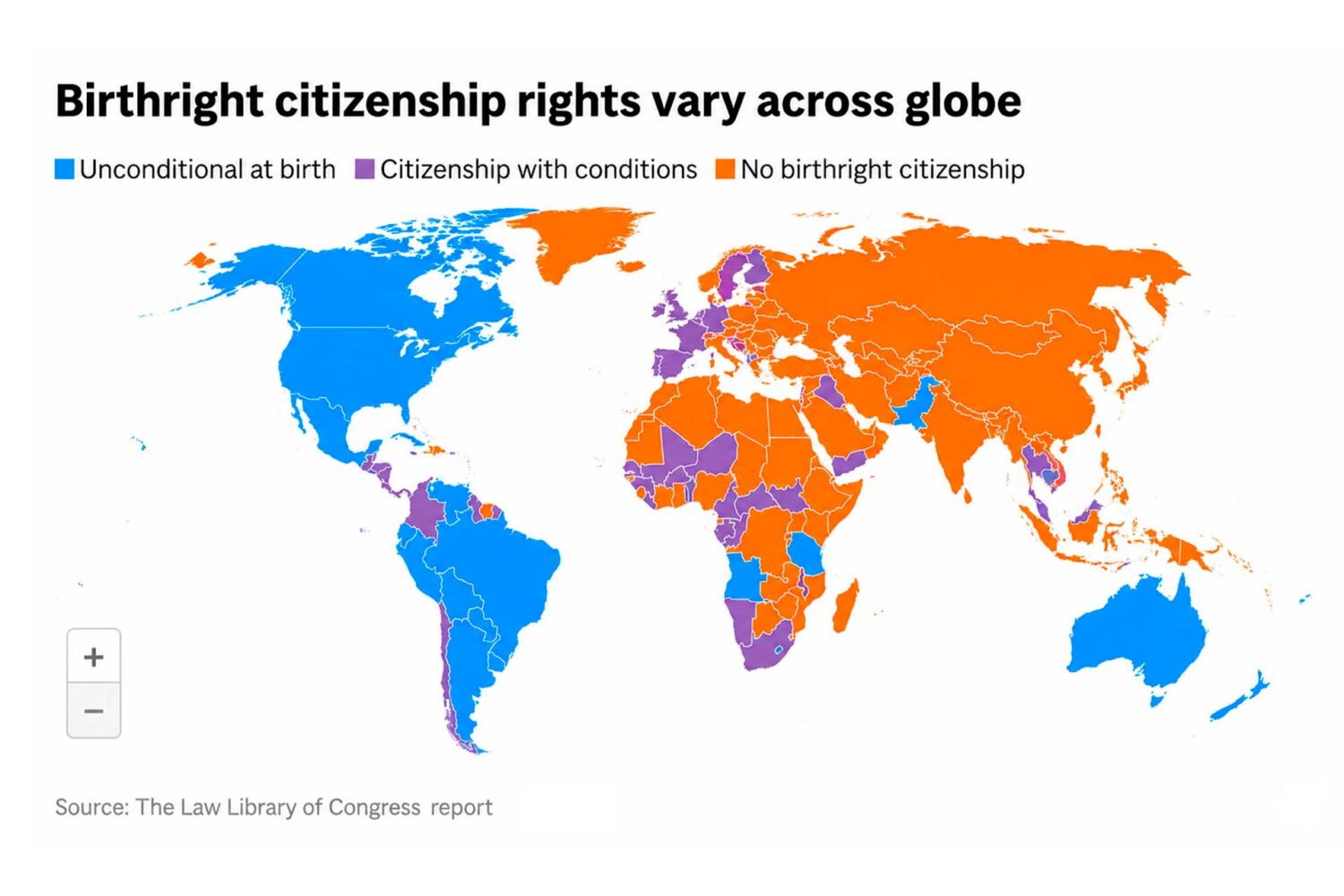
If people use the term “birthright citizenship” in everyday debate, they often mean territorial birthright citizenship only. On that narrower question, Pew Research Center’s March 2026 chart, based on the GLOBALCIT Citizenship Law Dataset, shows countries using five public categories: generally applicable automatic jus soli, parent-born-in-country rules, parent-legal-residence rules, group-limited rules, and systems where citizenship is generally available by birth in the territory but must be claimed through an application or declaration. That chart makes clear that unconditional jus soli is concentrated mainly in the Americas and the Caribbean, rather than being a global norm.
The key legal exceptions are also consistent across many systems. Comparative sources and official government guidance commonly exclude the children of diplomats, and some states also maintain historical or war-related exceptions for children of enemy occupation forces. International law, meanwhile, pushes states in the opposite direction through statelessness safeguards, urging or requiring nationality for children who would otherwise be stateless. UNHCR and OHCHR both emphasize that states should grant nationality to children born in the territory if they would otherwise have none.
For families, the practical lesson is simple: never assume that a birth certificate automatically proves citizenship. Birth registration is vital because it proves place of birth and parentage, but nationality still depends on the law of the country involved. UNHCR stresses that birth registration is a key safeguard against statelessness because it helps establish eligibility for nationality; official country guidance from the UK, France, Belgium, Australia and Chile likewise treats proof of birth, parentage, residence, and legal status as central to citizenship recognition.
Types of Birthright Citizenship
In comparative nationality law, birthright citizenship is structured around several core legal models that define how citizenship is acquired at birth.
What the main legal models mean
Jus soli means citizenship is linked to the place of birth. In a pure form, a child born on the territory becomes a citizen at birth, with narrow exceptions such as diplomats. Jus sanguinis means citizenship is passed from a citizen parent, whether the child is born inside or outside the country, though many states limit transmission abroad after one or two generations. GLOBALCIT explains that these principles are not true opposites in modern law, because most countries mix them.
Unconditional jus soli is the strongest territorial model. Pew’s public chart based on GLOBALCIT labels this category “generally applicable, automatic,” meaning citizenship is granted automatically at birth without a parental residence or prior-birth requirement.
Conditional jus soli covers systems where birth in the territory matters, but is not enough by itself. Conditions may require a parent to be lawfully resident, a parent to have been born in the country, or the child to declare or register later. Germany, Ireland, the UK, France, Belgium, Chile and Australia are good examples of how different those conditions can be.
Mixed systems combine territorial and descent rules. Belgium, for example, grants nationality at birth to a child born in Belgium if a foreign-national parent was also born in Belgium and lived there for at least five of the previous ten years, and it also has a declaration route for long-resident immigrant families before the child’s twelfth birthday. France combines descent, a “double jus soli” rule where a parent was also born in France, and later declaration or automatic acquisition for some children born in France to foreign parents who grow up there. Germany adds citizenship at birth for children born to non-German parents if one parent has the required lawful residence and permanent status.
Legal requirements and recurring exceptions
Across jurisdictions, the legal criteria usually fall into a small number of recurring buckets: place of birth, parentage, parent residence status, earlier family connection to the country, and avoidance of statelessness. Official guidance in Belgium, Ireland, Germany, the UK and Chile demonstrates this pattern clearly.
The classic exceptions are also remarkably stable. The Law Library of Congress notes that children of diplomatic personnel are routinely excluded from birthright citizenship rules, and the UK’s official guidance separately lists diplomats and children of an enemy alien in occupation as exceptions to automatic citizenship by birth in the territory.
Statelessness safeguards are the major humanitarian counterweight to restrictive nationality rules. UNHCR and OHCHR both stress that states should grant nationality to a child born in the territory if that child would otherwise be stateless, and the 1961 Convention on the Reduction of Statelessness is built around that principle. Belgium’s official site shows how this works in practice, granting nationality to a child born in Belgium who would otherwise be stateless, while also limiting the safeguard where another nationality can be obtained through simple administrative steps.
Dual citizenship implications
Birthright citizenship often produces dual or multiple citizenship automatically. A child born in a jus soli state to parents from a jus sanguinis state may acquire both nationalities at birth. According to GLOBALCIT’s 2025 report, acceptance of dual citizenship has risen sharply over time: only 6% of countries accepted it in 1960, compared with 51% by 2024. Still, acceptance remains uneven, and dual-citizenship restrictions continue to matter for some families.
Official country guidance shows why families should check both citizenships, not just one. The UK’s guidance warns that some countries automatically strip nationality when another citizenship is acquired, or continue to impose duties such as military service. Germany’s 2024 reform moved in the other direction by expanding multiple-citizenship acceptance and lowering the parental residence threshold for children born in Germany to foreign parents.
Not sure which citizenship path applies to you? Leave a request for a consultation — our experts will assess your case and recommend the best option.
Schedule a free consultation and get detailed information from Unioncitizenship lawyers. Start the process today!

Countries With Birthright Citizenship
The lists below follow the public country-by-country chart published by Pew Research Center on 31 March 2026, based on the GLOBALCIT Citizenship Law Dataset. The chart distinguishes unconditional automatic jus soli from four different conditional or limited categories.
Countries with unconditional jus soli
The following countries offer unconditional jus soli citizenship, meaning a child automatically becomes a citizen at birth regardless of the parents’ nationality or status:
- Antigua and Barbuda
- Argentina
- Barbados
- Belize
- Benin
- Bolivia
- Brazil
- Canada
- Chad
- Cuba
- Dominica
- Ecuador
- El Salvador
- Grenada
- Guatemala
- Guyana
- Honduras
- Jamaica
- Mexico
- Mozambique
- Nicaragua
- Pakistan
- Panama
- Peru
- St. Kitts and Nevis
- St. Lucia
- St. Vincent and the Grenadines
- Trinidad and Tobago
- Tuvalu
- United States
- Uruguay
- Venezuela
Note: This list reflects countries classified by Pew/GLOBALCIT as having “generally applicable, automatic” birthright citizenship systems.
Countries with conditional jus soli
| Rule type | Countries |
|---|---|
| Parents must also have been born in the country | Belgium, Brunei, Burkina Faso, Cambodia, Cameroon, France, Gabon, Greece, Guinea, Iran, Luxembourg, Mali, Malta, Morocco, Netherlands, Niger, Portugal, Republic of the Congo, Senegal, Sierra Leone, Spain, Timor-Leste, Togo, Tunisia, Yemen |
| At least one parent must be a legal resident | Australia, Cape Verde, Chile, Colombia, Dominican Republic, Germany, Ireland, Kosovo, Malaysia, Namibia, New Zealand, Sao Tome and Principe, Thailand, United Kingdom |
| Limited to particular groups | Guinea-Bissau, Haiti, Israel, Liberia, Uganda |
| Generally applicable, but citizenship must be claimed by application or declaration | Costa Rica, Moldova, Paraguay |
This table follows the public category labels in Pew’s March 2026 chart. In plain English, these are all forms of conditional jus soli because birth in the territory matters, but alone is not enough.
Notable mixed systems
| Country | Why it matters | Core rule |
|---|---|---|
| Belgium | Strong example of “double jus soli” and long-residence family integration | A child born in Belgium is Belgian if a foreign-national parent was also born in Belgium and lived there for five of the ten years before birth; there is also a declaration route before age 12 for children born and raised in Belgium to long-resident foreign parents. |
| France | Classic European mixed model | A child born in France to foreign parents is French at birth if one parent was also born in France; otherwise nationality may arise later through declaration or automatically at adulthood if residence conditions are met. |
| Germany | Parent-residence jus soli | A child born in Germany to foreign parents acquires German citizenship at birth if one parent has lived there lawfully for at least five years and has an unlimited right of residence. |
| Ireland | Post-2005 conditional model | For births from 1 January 2005 onward, parental citizenship or residence history determines whether a child born in Ireland is Irish at birth. |
| United Kingdom | Settled-status model | A child born in the UK is automatically British if a parent was British or “settled” at the time of birth; other UK-born children may later register. |
| Australia | Permanent-residence model plus statelessness safeguard | Birth in Australia no longer gives automatic citizenship in all cases; present rules depend heavily on parents’ resident status, with special protection for children born there who are stateless. |
| Chile | Strong jus soli tradition with a “transient foreigner” carve-out | Children of diplomats and “temporary foreigners” are excluded from automatic citizenship, but Chile has a formal opt-in route and anti-statelessness provisions. |
| Colombia | Residence-based jus soli with major anti-statelessness reforms | Constitutional “domicile” rules are supplemented by special protection for many children of Venezuelan parents born in Colombia. |
These examples come from official government pages and current public legal guidance rather than migrant folklore.
Major legal changes since 2015
The last decade did not create a global shift in one direction, but it did produce several very important country-level changes, especially in Europe and Latin America:
- 2018 – France introduces tighter Mayotte-specific jus soli rules.
- 2019 – Colombia launches “Primero la Niñez” for children of Venezuelan parents at risk of statelessness.
- 2021 – Chile’s immigration law narrowed the definition of “transient foreigner” and codified a statelessness safeguard.
- 2024 – Germany lowers the parental lawful-residence threshold from 8 years to 5 years.
- 2025 – France tightens Mayotte rules again.
- 2025 – Colombia extends its exceptional anti-statelessness measure to 2027.
A closer look at the evidence shows why “birthright citizenship” is too broad a phrase for serious analysis. Germany liberalized one conditional jus soli path; France restricted a territorial path in Mayotte; Colombia expanded anti-statelessness access; and Chile tried to lock in a narrower, more legally defensible definition of who counts as merely “passing through.”
What the practical process looks like
In automatic systems, there is usually no citizenship application in the immigration sense. The child is a citizen by operation of law, and the practical process is to register the birth and then obtain proof documents such as a birth certificate, nationality certificate, ID card or passport. Australia’s official guidance on confirming citizenship, Ireland’s official citizenship guidance, and the UK’s official “check if you’re a British citizen” pages all reflect this approach.
Where citizenship is conditional or deferred, the workflow is more procedural. France requires a declaration route for some minors born in France to foreign parents, with proof of residence and other civil-status documents. Chile’s “option to citizenship” route is applied online through SERMIG, followed by review, fee payment if approved, and then civil-registry document issuance. The UK uses later “registration” for some UK-born children who were not automatic citizens at birth.
A practical cross-border checklist looks like this:
- Register the birth immediately and obtain an official birth certificate.
- Check the legal basis: place of birth, parent citizenship, parent residence, parent birth in the territory, or statelessness safeguard.
- Collect proof of the parents’ status at the time of birth, such as residence permits, settlement documents, or nationality certificates.
- File any declaration or registration on time if the route is not automatic.
- Apply for proof documents such as a nationality certificate, passport, or national ID card.
Processing time
The most important distinction is between legal status and administrative proof. In unconditional or automatic jus soli systems, citizenship exists from birth, so the “processing time” often refers only to birth registration and later issuance of documents. In declaration or registration systems, the clock starts when the citizenship claim is formally filed.
Official examples show how variable those timelines are. France’s declaration procedure for certain children born in France is deemed registered if there is no response within six months once the file is complete. The UK’s guidance for people applying for citizenship after being born in the UK says applicants will usually get a decision within six months. Chile’s public SERMIG guidance explains the sequence of submission, review, fee payment and issuance, but does not publish a simple fixed service standard on the page itself.
Costs and fees
Costs vary dramatically because some families are only proving an existing citizenship, while others are using a later registration or declaration route. Colombia’s 2019 anti-statelessness measure for children of Venezuelan parents expressly states that the process is free, and it even provided a free corrected civil-registration copy for already-registered children. By contrast, the UK’s official nationality-fee table sets child registration as a British citizen at £1,000 from 8 April 2026. Chile’s official SERMIG fee schedule lists CLP 38,697 for “Option to Chilean citizenship.”
There are also indirect costs. France’s official page for children born in France to foreign parents requires documents proving residence, plus certified translations and, in some cases, legalization or apostille for foreign documents. Even where the citizenship procedure itself is free or low-cost, document procurement can still be expensive.
A useful benchmark is that some civil-registration systems charge no state fee at all for birth registration and can issue a birth certificate free on request. Estonia’s Interior Ministry says exactly that for birth registration there. That does not prove a universal rule, but it underlines a practical truth: the real price of “birthright citizenship” often depends less on nationality law than on the civil-status bureaucracy around it.
Renewal, extension and pathways if a child is not a citizen at birth
Citizenship itself generally does not expire, so there is usually no “renewal” of the citizenship status. What expires are passports, national IDs, residence permits or temporary administrative programmes. That is why a blog article on birthright citizenship should distinguish between renewal of citizenship evidence and renewal of immigration status. This is an inference supported by official country guidance showing that automatic citizens typically proceed directly to passports or evidence-of-citizenship documents rather than renewing nationality itself.
Where a child is not a citizen at birth, later pathways usually fall into four main categories:
- Later registration based on childhood residence.
A child may become eligible after living in the country for a certain period. For example, a UK-born child can register if a parent later becomes settled or if the child has lived in the UK until age 10. - Later declaration during adolescence or adulthood.
Some systems allow citizenship to be claimed later through a formal declaration. In France, certain children born to foreign parents can acquire citizenship this way, or automatically at adulthood if conditions are met. - Ordinary naturalization after residence.
Standard naturalization rules apply after meeting residence requirements. Ireland allows applications after residence (3 years for a child via a parent, typically 5 years for adults), while Australia offers citizenship through its conferral route for permanent residents. - Statelessness route.
Special safeguards exist for children who would otherwise be stateless. Countries such as Belgium, Ireland, and Australia provide legal pathways to grant citizenship in these cases.
These are not fallback theories but standard legal pathways reflected in current official guidance.
Why birthright citizenship claims are denied
The most common refusal ground is simple: the applicant did not actually meet the legal trigger at the moment of birth. In the UK, a child born in the territory is usually automatically British only if a parent was British or “settled” at the time of birth. In Germany, the relevant parent must have had both the necessary lawful residence period and an unlimited right of residence. In Ireland, births after 31 December 2004 turn largely on parental nationality or residence history.
A second common problem is missing or weak documentary proof. France requires civil-status documents, residence evidence, translations and sometimes apostille or legalization. Chile requires the correct birth certificate wording, identity documents and submission within the legal deadline. SERMIG also says proceedings may be treated as abandoned if requested background information is not provided.
A third issue is good-character, fraud or immigration-history objections in systems that require registration, declaration or discretionary approval. The UK’s official guidance says children aged 10 or above must be of good character for certain registration routes, and it notes that citizenship will normally be refused in some immigration-breach scenarios, though there is room to account for circumstances outside a child’s control. France’s official page says the public prosecutor may challenge a declaration within two years if conditions were not met or if there was falsehood or fraud.
A fourth issue is assuming statelessness safeguards apply when another nationality is realistically available. Belgium’s official guidance is explicit: a child born in Belgium after 26 December 2006 will not receive Belgian nationality under the statelessness safeguard if the parents can obtain another nationality for the child by completing administrative measures with their consular authorities.
Need help avoiding a refusal? Leave a request for a consultation — our specialists will review your case, check the legal grounds and documents, and explain which birthright citizenship route may apply to your situation.
Schedule a free consultation and get detailed information from Unioncitizenship lawyers. Start the process today!

Common misconceptions
Myth: A birth certificate automatically proves citizenship.
Not necessarily. Birth registration proves facts like the date, place and parentage of birth, but nationality still depends on the citizenship law that applies. UNHCR treats birth registration as crucial evidence for nationality claims precisely because it is not the same thing as nationality itself.
Myth: If a baby is born in Europe, the baby automatically becomes a citizen.
False. Ireland, Germany, Belgium, France and the UK all impose important parentage, residence, or later-registration conditions in at least some cases.
Myth: The United States is the only country with birthright citizenship.
False. Pew’s public chart lists numerous unconditional jus soli countries in the Americas, Caribbean, Africa, Asia and Oceania, including Canada, Mexico, Brazil, Argentina, Pakistan and Tuvalu.
Myth: Birthright citizenship always means jus soli only.
In legal scholarship and comparative datasets, birthright citizenship includes both territorial and descent-based acquisition at birth. GLOBALCIT states this directly.
Myth: Dual citizenship is always allowed if a child gets two nationalities at birth.
Not always. GLOBALCIT shows dual-citizenship acceptance has become much more common, but not universal, and the UK’s own guidance warns that some countries may strip nationality or impose continuing duties even where another citizenship is acquired.
Expert tips for getting the law right
Getting citizenship outcomes right often depends on details that go beyond basic legal summaries:
- The first expert rule is to check both the written law and the current administrative practice. Chile is the best cautionary example: for years, an expansive administrative understanding of “transient foreigner” created problems for children born in Chile to parents in irregular situations, even though the country is usually described as a jus soli state. The 2021 law narrowed the concept and added an explicit statelessness safeguard, but the history shows why families should never rely on one-sentence summaries online.
- The second rule is to preserve time-specific proof. Many systems care about exactly what the parent’s status was at the time of birth, not later. Germany looks to lawful residence and an unlimited right of residence at birth; the UK looks to whether a parent was British or settled when the child was born; Ireland looks to parental citizenship or residence history before birth; and Belgium’s mixed routes often require proof of earlier residence.
- The third rule is to register the birth as early as possible. UNHCR and IOM both stress the role of civil registration in preventing statelessness and securing legal identity. Delayed registration does not always destroy a citizenship claim, but it often makes the paperwork harder and the proof burden heavier.
- The fourth rule is to think two steps ahead about dual citizenship and residence status. A child may already be a citizen of one country while a second citizenship claim is pending elsewhere, or may need a residence permit while nationality is being sorted out. Official UK guidance warns that some countries do not tolerate multiple nationality.
Real-case examples that matter
Recent country examples show how citizenship rules operate in practice and how states adjust them in response to real-world challenges:
- Colombia and children of Venezuelan parents. This is one of the clearest recent examples of a state using nationality law to prevent childhood statelessness. In 2019 Colombia adopted the exceptional “Primero la Niñez” measure for children born in Colombia to Venezuelan parents who could not effectively secure Venezuelan nationality, initially covering more than 24,000 children and making the process free. In 2025 the measure was extended again, and Colombia’s civil registry authority said it had by then recognized Colombian nationality for more than 139,000 children.
- Chile and the “child of a transient foreigner” problem. GLOBALCIT’s analysis of Chile explains that an administrative interpretation adopted in 1995 treated many irregular migrants as “transient foreigners,” which led to children being recorded in ways that could block recognition as Chilean. The government later changed course, the courts intervened, and the 2021 law legislated a narrower definition while adding an anti-statelessness provision. That is a strong reminder that nationality is not only about constitutions; it is also about how registrars and ministries classify parents in real life.
- Germany’s 2024 reform. Germany’s modernization of nationality law shows how conditional jus soli can become more inclusive without turning into pure jus soli. The reform lowered the parent-residence threshold from eight years to five years and preserved multiple citizenship more broadly, making automatic citizenship at birth more accessible for children of long-term migrant families.
- Mayotte and differentiated jus soli inside one state. France’s Mayotte rules show that nationality regimes can vary even within a single sovereign state. A 2018 law already restricted access to French nationality by birth there, and a 2025 law tightened the conditions again, requiring lawful residence of both parents for a defined period. This is one of the clearest recent examples of a territorial-birth rule becoming more restrictive.
If your family is dealing with a cross-border birth, a delayed registration, possible statelessness, or uncertainty about whether a child is a citizen by birth, professional legal support can make a real difference. A nationality or immigration lawyer can help verify the applicable law, gather the right proof of parentage and residence, protect the child’s status while documents are pending, and map parallel options for citizenship, passport evidence, or lawful residence in the meantime. In nationality matters, the best outcomes usually come from early document strategy, not crisis management after a refusal.




Find out details about obtaining an EU passport at a free consultation
Fill out a simple form and an immigration lawyer will contact you shortly.