


Best Education Systems in the World 2026: Top Countries Ranked
- What Country Has the Best Education in 2026?
- Top 10 Countries with the Best Education Systems (2026 Ranking)
- Comparison Table (K-12, Universities, Affordability, etc.)
- Best Countries by Education Category
- How Education Rankings Are Measured (Criteria Overview)
- Why These Countries Rank Highest (Explaining Key Drivers)
- Emerging Education Leaders (Estonia, Taiwan, etc.)
- Education Trends in 2026 (AI, Digital Learning, etc.)
Which countries lead in education? In 2026, a handful of nations consistently top global education rankings. They combine high-quality schooling, world-class universities, and inclusive access. Key highlights include:
- Finland and Singapore – Often cited for exceptional K-12 (Kindergarten to 12th grade) education quality and student performance. Finland emphasizes equity and top-tier teacher training, while Singapore leads in math and science scores.
- Top 10 Education Systems (2026) – A global study ranked China, South Korea, Finland, Hong Kong (China), Singapore, Canada, New Zealand, Japan, Australia, and the Netherlands as the top ten countries in overall education performance.
- Best by Category – The United States and United Kingdom dominate for higher education (with most of the world’s top universities). Nordic countries like Finland and Norway excel in education quality and offer free college tuition for residents. East Asian economies (Singapore, South Korea, Taiwan) score highest in STEM subjects.
- 2026 Trends – AI in classrooms and digital learning are on the rise, improving personalization but raising integrity concerns. There’s growing focus on student well-being and skills-based learning, as well as looming teacher shortages globally (by 2030, only 30 out of 197 countries may have enough teachers).
In short: Countries with the best education in 2026 marry strong public schooling, renowned universities, equitable access, and innovation. Below we break down the global rankings, comparisons, and key factors driving these top-performing education systems.
What Country Has the Best Education in 2026?
No single country dominates every aspect of education – the “best” depends on what’s measured. By some metrics, Asian education systems come out on top, whereas Western countries lead on others. For example, the latest Programme for International Student Assessment (PISA) study (a global exam of 15-year-olds) found that students in parts of China achieved the highest academic scores in the world, followed closely by South Korea and Finland. This suggests these countries have outstanding K-12 education quality.
On the other hand, a 2024 survey by U.S. News & World Report – which gauges public perceptions of education – ranked the United States as the best country for education. The U.S. earned this reputation thanks to its well-developed public school system and abundance of top-ranked universities. The United Kingdom came second and Germany third in that survey, reflecting strong higher education and training in those countries.
In short, multiple countries excel in 2026 depending on criteria: East Asian nations lead in student test scores, while Western nations are often recognized for quality universities and broad educational access. Many experts instead point to a group of consistently high-performing countries – such as Finland, Singapore, South Korea, Canada, and Japan – rather than a single “#1” nation. All of these invest heavily in education and have innovative, well-rounded systems. The following sections explore the top-ranking countries and what makes their education systems stand out.
Top 10 Countries with the Best Education Systems (2026 Ranking)
Various organizations release annual rankings of national education systems. Below are ten countries that repeatedly emerge at the top in 2026 comparisons, along with what they’re known for:
- China – Academic Powerhouse: China’s students have posted record-breaking scores in international tests. In one global study, Chinese 15-year-olds earned the highest math and reading scores worldwide. Key regions like Beijing and Shanghai drive these results with rigorous curricula. China has also expanded access to education on a massive scale and is rapidly improving its universities.
- South Korea – High Achievers with Intense Work Ethic: South Korea boasts near-universal literacy and produces top-tier math and science students. Korean schools are known for long hours and a strong exam culture. This pays off in PISA, where Korea consistently ranks among the top few countries in reading, math, and science. Education is highly valued culturally, and government reforms in 2026 continue aiming to reduce student stress while maintaining quality.
- Finland – World-Class K-12 Education: Finland is often regarded as a gold standard for education policy. It forgoes high-stakes testing and focuses on equal opportunity and quality teaching. All Finnish teachers must hold a master’s degree, making teaching a respected, research-based profession. Finnish students have consistently strong outcomes – Finland was ranked 4th globally on the UN Education Index (as of 2019). Although other nations have caught up in recent PISA results, Finland’s students remain among the top performers in Europe, especially in reading and science.
- Hong Kong (China) – Elite Results in East Asia: Hong Kong’s education system combines Chinese and British influences, yielding excellent results. Hong Kong students rank with the best in the world in math and science – for instance, Hong Kong was among the top five in PISA 2022’s global mathematics league table. The city emphasizes bilingualism (Chinese and English) and competitive exams that secure its students spots in top universities worldwide.
- Singapore – Top of the Class Globally: Singapore is number one in multiple international assessments, thanks to a rigorous national curriculum. In PISA 2022, Singapore led the world in mathematics with an average score of 575, far above the OECD average. Science and reading scores are also among the highest. Key to Singapore’s success is a focus on mastery of fundamentals, continuous teacher training, and strategic support for weaker students. The result is an education system that is both high-quality and consistently produces skilled graduates, especially in STEM fields.
- Canada – High Outcomes and Inclusivity: Canada stands out for both strong academic results and equity. Canadian 15-year-olds perform above the OECD average in reading, math, and science, with particularly high reading literacy. The public school system, largely managed at the provincial level, ensures free education through secondary school and boasts high graduation rates. Canada also has one of the world’s highest tertiary education attainment rates (over half of adults hold a college degree). Its approach – rigorous academics combined with inclusive policies for immigrants and minorities – makes Canada a fixture in the top 10.
- New Zealand – Holistic and High-Performing: New Zealand emphasizes a well-rounded education with an innovative curriculum (emphasizing creativity and critical thinking). Literacy rates and school enrollment are near-universal. New Zealand often appears in the top tier of education rankings. Students consistently perform well on international assessments, and the country’s universities are globally respected. An informal atmosphere, strong support for Māori and Pasifika education, and quality teaching all contribute to New Zealand’s success.
- Japan – High Standards and Strong Universities: Japan has a highly educated population and a school system known for discipline and effectiveness. Japanese students score among the world’s best, especially in science and math. In 2022, Japan’s 15-year-olds scored above OECD averages in all subjects. The country also boasts top universities (like the University of Tokyo and Kyoto University) and a culture that highly values education. Challenges include intense competition and recent efforts to foster more creativity in learning.
- Australia – Quality Education and Robust Funding: Australia makes the top 10 thanks to strong outcomes and investment in education. Australian schools perform well internationally, and the country spends about 5–6% of its GDP on education (on the higher end globally). The result is good infrastructure, well-trained teachers, and small class sizes. Australian universities (ANU, University of Melbourne, etc.) rank among the world’s best. With English as the medium of instruction and a diverse student body, Australia is also a top destination for international students.
- Netherlands – Strong Foundations and Skills: The Netherlands combines high-quality early education (virtually all children attend preschools) with a balanced, skill-focused school system. Dutch 15-year-olds rank in the top tier for math and science proficiency, and the country places great emphasis on student well-being and work-life balance. Higher education is also excellent – Dutch universities like Delft and Wageningen are renowned in fields like engineering and agriculture. Moderate tuition fees and generous grants make tertiary education accessible. Overall, the Dutch system is often praised for producing academically strong and well-rounded students.
If you’re planning to move to a country with a strong education system for yourself or your children, it’s important to understand the available immigration options and requirements. Leave a request for a consultation to get personalized guidance and choose the best pathway for your relocation.
Schedule a free consultation and get detailed information from Unioncitizenship lawyers. Start the process today!

Comparison Table (K-12, Universities, Affordability, etc.)
How do the top countries compare across different education measures? The table below provides a snapshot of key indicators for select high-performing education systems:
| Country | K-12 Performance (PISA 2022) | Top Universities (Global Ranking) | Higher Ed Affordability | Adult Literacy Rate |
|---|---|---|---|---|
| Finland | Among Top 10 in OECD for reading & science (high equity) | No universities in global top 50; University of Helsinki ~#104† | Tuition-free public universities for EU citizens | 99% |
| South Korea | Top 5 globally in math and reading (PISA) | Seoul National University, KAIST in global top 100† | Public universities low-cost (not free); high private tuition | 98% |
| Singapore | #1 in PISA math (575 points); top-tier in science and reading | National University of Singapore (#8 QS 2024)†; NTU (#26)† | Partially subsidized; student aid available (no free tuition) | 97% |
| United States | Above-average in reading & science; below avg in math | 7 of the world’s top 10 universities are in the U.S. (e.g. MIT, Harvard) | High tuition costs (no free college); financial aid system | 99% |
| United Kingdom | Above OECD average in all subjects (PISA 2022) | 3 of global top 10 universities in UK (Oxford, Cambridge, etc.) | Public universities charge tuition (~£9k/year for locals) | 99% |
| Canada | Excelling in reading, strong in math & science | 3 universities in top 50 (University of Toronto, McGill, UBC)† | Public schooling free; moderate tuition for university (some provinces offer rebates) | 99% |
Key takeaways: Finland and South Korea illustrate two K-12 success models – Finland’s emphasis on equity vs. Korea’s intensive academics – both yielding outstanding literacy and test scores. Singapore combines top-notch basic education with rapidly improving universities. The U.S. and U.K. clearly lead in higher education prestige (concentrating the world’s best universities), though their K-12 outcomes are solid but not chart-topping. Affordability varies widely: countries like Finland and Germany offer tuition-free college for citizens, whereas English-speaking nations tend to have higher tuition fees offset by scholarships or loans. All these nations enjoy near-universal literacy and high enrollment, underscoring that basic education needs are being met even as quality differentiators set them apart.
Best Countries by Education Category
Different countries shine in different aspects of education. Here are the leaders in specific categories as of 2026:
K-12 Education (Primary and Secondary)
For school-level education, the top performers are those with the highest student achievement and well-rounded school systems. Singapore is often considered the best in K-12 quality when looking at student outcomes – it ranked first in the world for math and consistently near the top in science and reading on PISA. Its students benefit from a challenging curriculum and effective teaching methods. Other East Asian systems like South Korea and Chinese Taipei (Taiwan) are not far behind, regularly ranking among the top performers in math and science exams. These countries have a strong culture of education, extensive use of tutoring, and rigorous standards.
Outside Asia, Finland remains a standout in K-12. Finnish students routinely score at or near the top among Western countries. Importantly, Finland accomplishes this with low inequality – differences between the highest and lowest performing students are smaller than elsewhere. This means Finland excels not just in average scores but in giving all children a strong education. Estonia is another rising star: it now tops Europe in PISA results, ranked #1 in Europe for math, science, and reading in 2022. Estonia’s success shows in part due to its focus on digital learning tools and equitable instruction.
In summary, the best K-12 systems are found in East Asia (for raw scores and STEM excellence) and Northern Europe (for holistic quality and equity). Singapore, South Korea, Finland, and Estonia would be considered exemplars of primary and secondary education in 2026.
Higher Education (Universities and Colleges)
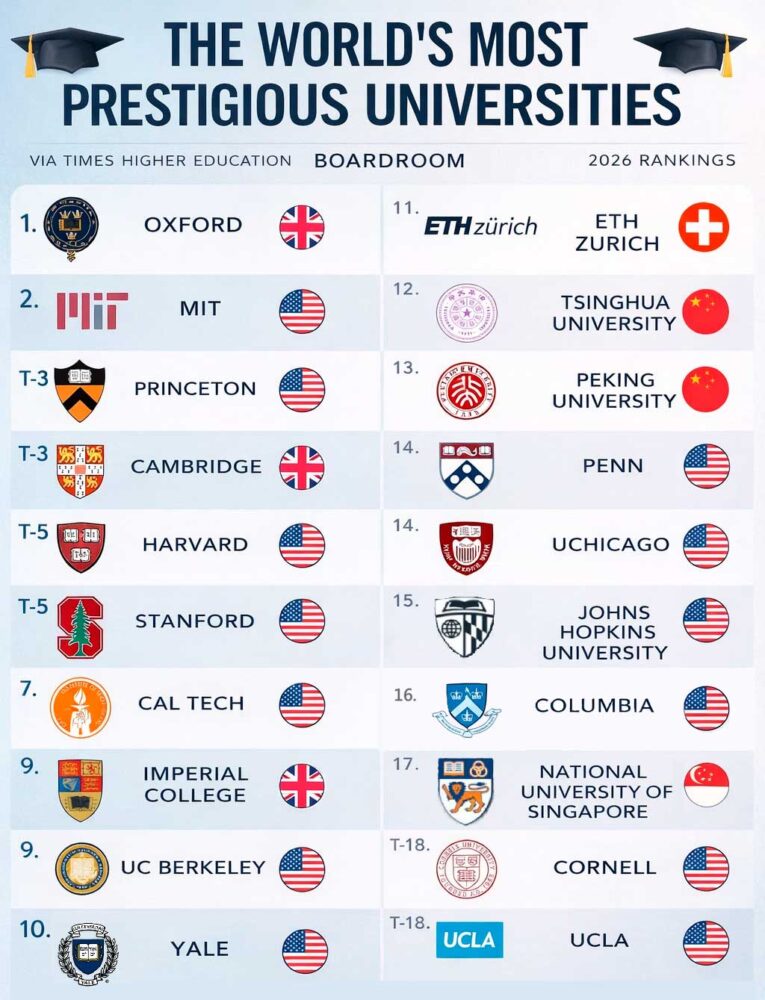
When it comes to universities and colleges, the United States and United Kingdom are the clear front-runners. The U.S. is home to 7 of the world’s top 10 universities, including famous institutions like Harvard, MIT, Stanford, and Yale. Similarly, the U.K. hosts prestigious universities like Oxford, Cambridge, and Imperial College London – three of the global top ten. These countries have long histories of higher education excellence, substantial research funding, and the ability to attract top talent from around the world.
Other countries with outstanding higher education include Germany (strong engineering and research universities like TU Munich), Australia (Australian National University, University of Melbourne among top 40 globally), and Canada (University of Toronto, McGill, UBC are highly ranked). Japan and South Korea have also been climbing in global university rankings, with universities such as Tokyo, Kyoto, Seoul National, and KAIST gaining international recognition.
One notable trend is that English-speaking countries dominate global university rankings – partly because of the international nature of research publication and student mobility. However, countries like China are rapidly investing in their universities; China now has several institutions (Tsinghua, Peking University) in the world top 50, reflecting its push to become an educational as well as economic superpower.
Overall, if the question is “Who has the best universities?” – the answer in 2026 remains the U.S. and U.K. by most metrics, but with other nations closing the gap.
Affordability and Access
The best education system isn’t just about quality – affordability and access are crucial too. In this category, many European countries lead due to strong public funding of education. Germany famously offers tuition-free education at public universities for both domestic and international students (in most states). Nordic countries such as Finland and Norway also charge no tuition for native and EU students at public institutions, and they heavily subsidize education at all levels. This means a student in Helsinki or Berlin can attend university virtually free of charge, which promotes higher enrollment and equality of opportunity.
By contrast, in countries like the United States or United Kingdom, higher education often comes with significant tuition fees. The U.S. has high college costs (averaging around $10,000 per year at public in-state universities and higher for private colleges), though it provides needs-based financial aid and scholarships. The U.K. has capped undergraduate tuition (about £9,250 per year in England for home students). These higher costs can be a barrier, so these countries don’t lead in affordability – however, their robust scholarship systems and community college pathways help mitigate the burden for many students.
In terms of access to basic education, most developed countries have near 100% enrollment in primary and secondary school. Some developing nations struggle in this area, but encouragingly, global youth literacy and school enrollment have risen steadily. Notably, countries like South Korea and Japan have near-universal high school graduation, and even at the tertiary level, over 70% of young adults pursue post-secondary education. Canada also excels in tertiary access, with one of the world’s highest college attainment rates (over 60% of adults).
Top marks for affordability and access go to countries that remove financial barriers. Germany, the Nordics (Finland, Norway, Denmark, Sweden), and also France (low university fees and generous public funding) are all exemplary in making education accessible to all socio-economic classes.
STEM Education (Science, Technology, Engineering, Math)
In the critical fields of STEM, several countries distinguish themselves at different levels of education. At the school level, East Asian countries have a strong lead. As mentioned, Singapore, South Korea, Taiwan, Japan, and China (Beijing/Shanghai regions) dominate international exams in math and science. For example, in PISA 2022 mathematics, the top six scores were all achieved by Asian education systems. Students in these countries often begin intensive math/science education early, supported by both school and after-school tutoring (“cram schools” are common in East Asia). The payoff is seen in international Olympiads and assessments, where East Asian teams win a disproportionate share of gold medals in math and science.
When considering higher education and research in STEM, the United States leads in many respects. American universities produce the largest number of scientific publications and patents, and schools like MIT, Caltech, and Stanford are world-renowned for engineering and technology. The United Kingdom (Cambridge, Imperial, Oxford) and Switzerland (ETH Zurich) also host top engineering and science programs. Germany is known for engineering excellence through its technical universities and apprenticeship programs that feed skilled workers into STEM industries.
Emerging STEM hubs include China (which is investing billions in research and producing huge numbers of STEM graduates) and India (home to IITs and a large IT workforce). While India’s basic education is uneven, its top STEM colleges rival the best, and it produces many of the world’s engineers and software developers.
In summary, for STEM education: At school level, look to Singapore, Taiwan, South Korea, Japan, and China for the strongest math and science foundations. At university/research level, the U.S. and U.K. remain powerhouses, with Germany and China rising quickly in scientific output.
How Education Rankings Are Measured (Criteria Overview)
How do we rank “education” by country? There is no single definitive measure – instead, different rankings focus on different criteria. Here’s an overview of the main benchmarks used in 2026:
- International Standardized Tests: Exams like PISA (Programme for International Student Assessment) and TIMSS compare the academic performance of students across countries. PISA, run by the OECD every three years, tests 15-year-olds in reading, math, and science. Countries that top PISA (e.g. Singapore in math, Estonia in Europe) are considered to have high-performing school systems. These tests gauge how well students can apply knowledge and think critically. However, they mainly measure academic outcomes and may favor certain curricula or cultural approaches.
- Educational Attainment and Literacy: Another way to compare countries is by the percentage of the population that reaches certain education levels and basic literacy. The Education Index by the UNDP is one such composite measure – it combines mean years of schooling (how many years the average adult has attended school) and expected years of schooling for children. Countries like Norway and Germany score extremely high on this index (around 0.96–0.97 on a scale of 0 to 1, among the top in the world). Adult literacy rates are also telling – in many developed nations, literacy is effectively 99%, whereas some poorer countries still have literacy rates below 70%. High literacy and graduation rates boost a country’s education ranking. (For instance, Ukraine, Georgia, and Poland all report near-100% adult literacy.)
- Higher Education Quality: To assess a country’s universities, global rankings such as QS World University Rankings and Times Higher Education (THE) Rankings are commonly used. These consider research output, academic reputation, faculty quality, internationalization, etc. A country that has many institutions in the top 100 or top 200 (like the U.S., U.K., and increasingly China) is viewed as having a strong higher education system. Other data points include the number of STEM PhDs produced, research citations per capita, and Nobel Prizes won by alumni or faculty.
- Public Surveys and Perception: Some rankings rely on surveys of public opinion or experts. The US News & World Report “Best Countries for Education” ranking is one example – it gathers thousands of responses worldwide on questions like “Does this country have a well-developed public education system?”. The resulting score is a reflection of global perception, which is why the U.S. and UK score highly (owing to their famous universities and widespread use of English in academia). Perception-based rankings can differ from test-based rankings; for example, the U.S. was rated #1 by the US News survey in 2024, even though it ranks lower on PISA scores.
- Other Criteria: Some specialized indices look at things like education spending (percentage of GDP spent on education), teacher-to-student ratios, school enrollment rates, or skills-specific outcomes. For instance, the World Bank and UNESCO track metrics such as secondary school enrollment and completion rates. Many top-performing countries invest heavily in education; e.g. Finland, Denmark, and Australia each spend around 5–7% of GDP on education, enabling strong infrastructure and teacher support. Meanwhile, nearly all high-ranking countries have achieved gender parity in education and high enrollment from primary through secondary levels.
Each approach to ranking has its strengths and biases. That’s why the identity of the “best” education system can change depending on whether you prioritize academic achievement, educational attainment, funding levels, or global reputation. A holistic view looks at multiple metrics to get a full picture. Generally, countries that appear across the board – high test scores, high enrollment, high literacy, strong universities – are undisputed education leaders.
Why These Countries Rank Highest (Explaining Key Drivers)
What sets the top-tier education systems apart? A few key success factors are repeatedly seen in countries with the best education outcomes:
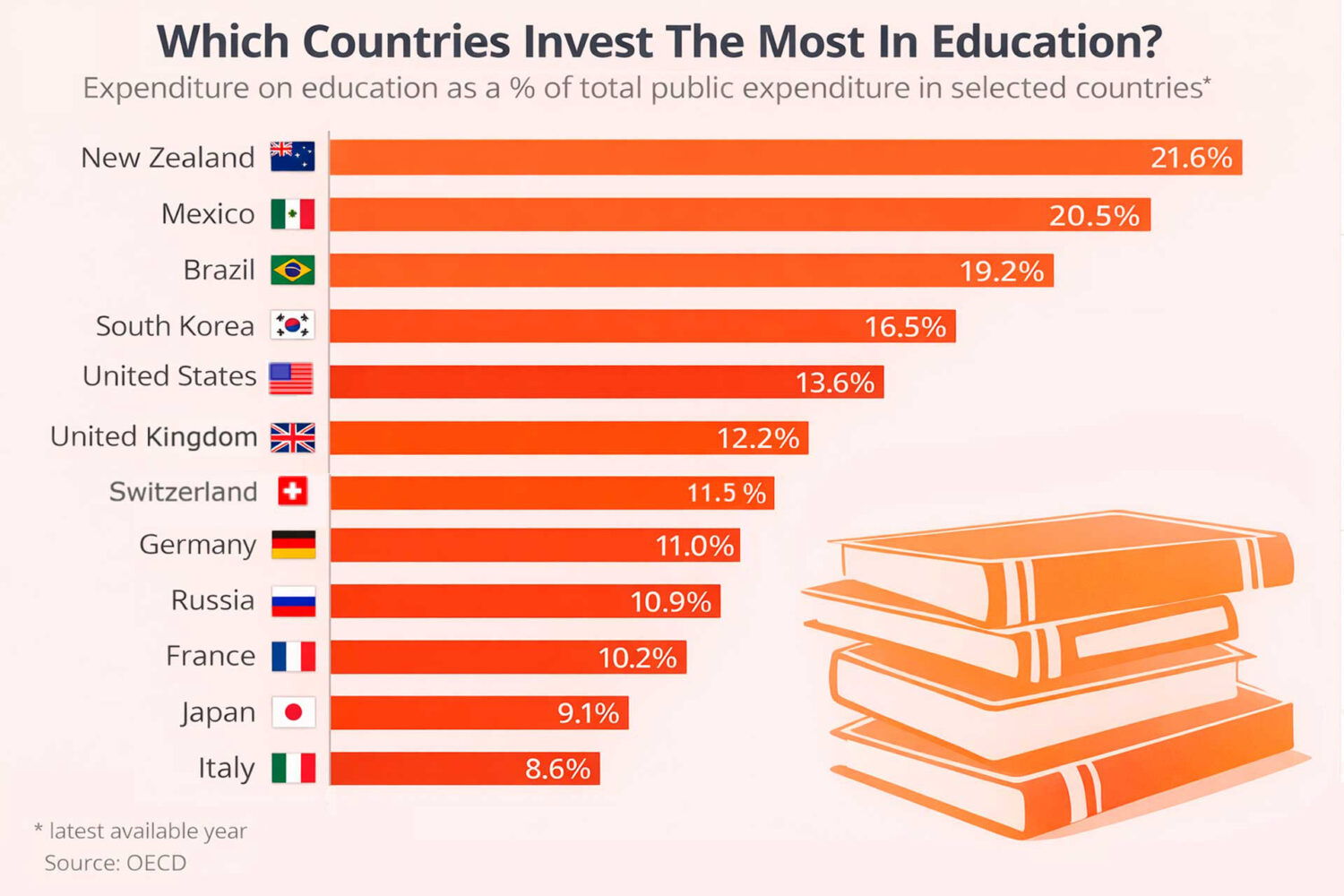
- Strong Investment in Education: Top countries tend to invest significantly in their education systems. This means not only high public spending, but spending it wisely. For example, Finland, Denmark, and Australia each spend roughly 6% of GDP on education – among the highest in the world – ensuring well-maintained schools, ample learning materials, and support programs. High investment often correlates with smaller class sizes, better facilities, and the ability to attract qualified teachers through decent pay. Of course, it’s not just about money; how funds are used matters. But almost all top-performing nations treat education as a priority in budgets.
- High Teacher Quality and Status: A common denominator in countries like Finland, Singapore, and South Korea is that teaching is a high-status, well-trained profession. Finland famously requires all teachers to earn a master’s degree in education. Finnish teacher colleges are highly selective, on par with law or medical schools in other countries. Singapore provides continuous training for teachers and rewards effective teaching with career advancement. In South Korea and Japan, teachers are respected and relatively well-paid, making the profession attractive. This focus on teacher quality leads to better instruction in the classroom. Teachers in these countries also benefit from mentoring and collaboration, ensuring that best practices spread throughout schools.
- Equity and Inclusion Policies: The highest-ranking systems strive to educate every child, not just an elite subset. Canada and Estonia, for instance, have policies to support students with special needs and those from disadvantaged backgrounds, resulting in smaller achievement gaps. Singapore identifies weaker students early and provides targeted support classes, successfully lifting their performance without lowering standards. Japan and Finland both have nationwide curricula, meaning a child in a rural area gets largely the same quality education as one in a wealthy city. By narrowing gaps between urban and rural schools, or rich and poor students, these countries ensure more consistent outcomes. Equity doesn’t mean mediocrity – it means bringing everyone to a high standard. Notably, many top countries also invest in preschool and early childhood education, to give all kids a strong start.
- Curriculum and Assessment Balance: Leading countries tend to have rigorous, up-to-date curricula but also avoid overburdening students with high-stakes exams (at least until the end of secondary school). Ireland and Poland recently reformed curricula to emphasize critical thinking and skills, which contributed to improved PISA results. Shanghai (China) and Singapore periodically revise their syllabi to cut rote memorization and include real-world problem solving. On the assessment side, nations like Finland use minimal standardized testing (teachers track progress mostly through class performance), whereas South Korea has famously intense exams – yet both systems perform well. The key is alignment: top countries ensure that what’s taught in the classroom is relevant and that assessments genuinely measure important skills. There is often a push for educational innovation as well – for instance, introducing coding, foreign languages, or ethics into the curriculum early on.
- Cultural Values and Expectations: Finally, it cannot be ignored that culture plays a role. In many top Asian countries, there is a strong cultural emphasis on education as the pathway to success, which means students are motivated and parents are highly involved. This can drive excellence (as seen in the extraordinary work ethic of students in South Korea or China’s big cities). In Finland and other Northern European countries, the cultural value is on learning for personal development – there’s less pressure on exams, but a deep respect for learning and reading. In Japan, concepts like hansei (self-reflection) and ganbaru (effort) in studies are instilled in students. In short, societal attitudes that value education highly, whether as a means to innovation or personal growth, create an environment where educational success is more likely.
In summary, top-ranked education systems are not accidents; they result from consistent policies and practices: ample funding, excellent teachers, inclusive programs, high standards, and a culture that prizes learning. When these factors come together, countries reap the rewards in literate, capable, and innovative younger generations. Policymakers around the world often look to these examples for inspiration in improving their own education systems.
If you’re considering moving to a country with a strong education system for yourself or your family, it’s important to choose the right destination and immigration pathway. Leave a request for a consultation to get personalized guidance and plan your relocation with confidence.
Schedule a free consultation and get detailed information from Unioncitizenship lawyers. Start the process today!

Emerging Education Leaders (Estonia, Taiwan, etc.)
Beyond the usual suspects, some emerging education leaders are gaining attention by 2026. These are countries (or regions) that have made significant strides and now rival the traditionally top-ranked nations:
- Estonia – This small Baltic country has become Europe’s best in education by many measures. In the PISA 2022 results, Estonia was the top-performing European nation, ranking in the global top 4 in reading, math, and science. What’s remarkable is Estonia’s focus on digital learning and equity. All schools have introduced e-learning tools (even before the pandemic), and students are taught computer programming from a young age. Estonia’s system is also very equitable – socioeconomic background has a smaller impact on performance there than in most countries. With strong outcomes and innovative practices, Estonia is a rising star to watch.
- Taiwan (Chinese Taipei) – Taiwan has long had strong academics, but it’s now frequently highlighted among the top performers globally. Taiwanese 15-year-olds consistently score near the top in math and science (often just behind Singapore and China). The education system in Taiwan is rigorous, with a heavy STEM orientation – Taiwan regularly produces world-class results in math Olympiads and science competitions. What’s emerging is also an effort to encourage more creativity alongside the traditionally strong discipline. Taiwanese students, for example, have shown resilience and well-being improvements in recent studies. Taiwan’s success, much like South Korea and Japan, comes from cultural emphasis on education and a well-organized school system.
- Ireland – Ireland’s education system has quietly become one of Europe’s best, especially in reading literacy. In the latest PISA, Irish students were essentially tied for #1 in reading in Europe (alongside Estonia). Ireland has invested in teacher training and maintained small class sizes in primary schools. A notable feature is the strong reading culture – Irish schools put heavy emphasis on language arts, which shows in their literacy rates. Ireland also has a high rate of secondary completion and sends a large proportion of students to higher education. While not always in the spotlight, Ireland is an emerging leader, particularly in English-language education quality.
- Poland – Over the past two decades, Poland has rapidly improved its school system. Once middling, Poland now scores above the OECD average in reading and science and has narrowed gaps between regions. Reforms that decentralized school management and updated curricula have paid off. Polish 15-year-olds today perform at similar levels to their peers in much wealthier Western European countries. Poland is often cited as an example of successful education reform in Eastern Europe.
- Vietnam – In the developing world, Vietnam has stunned observers by achieving very strong results relative to its income level. In an earlier PISA round, Vietnam’s students scored higher in science than many OECD countries – a sign that its basic education is delivering quality. Vietnam emphasizes basic literacy and math skills in early grades and has a culture of respecting teachers. Its education system still faces challenges (large class sizes, limited resources), but it’s an emerging success story often compared to East Asian systems for its effectiveness.
These emerging leaders show that high performance is not limited to the richest countries. Through focused reforms and cultural emphasis, they have elevated their education outcomes significantly. They also often serve as models for other nations in their region. For instance, Estonia’s digital approach is being studied by other EU countries, and Vietnam’s success is encouraging other Southeast Asian nations to invest more in primary education. As we look to the future, it’s possible that rankings in 2030 and beyond will feature even more newcomers if these trends continue.
Education Trends in 2026 (AI, Digital Learning, etc.)
Education in 2026 is not static – it’s evolving rapidly under the influence of technology, societal changes, and new research. Here are some major trends shaping education this year:
- Integration of AI in Education: The rise of artificial intelligence, especially generative AI (like large language model chatbots), is transforming classrooms and study habits. By 2024, 37% of lower-secondary teachers reported using AI tools in their job, for tasks like lesson planning or grading assistance. Teachers increasingly leverage AI-driven software for personalized tutoring, while students use AI apps for homework help. However, this comes with concerns – 72% of teachers worry AI could harm academic integrity (for instance, students getting AI to do their essays). In 2026 we see schools developing guidelines for AI use. Forward-looking education systems are training teachers and students in how to use AI as a supportive tool (for example, as a tutor or to generate practice questions) rather than a cheating shortcut. Overall, AI holds promise to personalize learning – adapting to each student’s pace – but educators are working to ensure it’s applied ethically and effectively.
- Digital and Hybrid Learning Environments: The COVID-19 pandemic massively accelerated the adoption of digital learning platforms. Even post-pandemic, many schools and universities have kept elements of hybrid learning – combining in-person and online instruction. By 2025, countries worldwide invested in stronger digital infrastructure for education, like learning management systems and devices for students. This means in 2026, it’s common for homework to be submitted online, classes to have virtual guest lectures, or students to use tablets instead of textbooks. Regions are also collaborating on digital education; for example, the EU has initiatives for shared e-learning resources. The trend is toward more “blended” learning that can flex between classroom and online as needed. At the same time, there’s recognition of “digital fatigue” – so many educators emphasize balancing screen time with hands-on, offline activities.
- Focus on Skills and Employability: A noticeable trend is education systems putting more emphasis on practical skills, not just academic theory. In secondary and higher education, there’s growth in career-connected learning – internships, vocational training, and coding bootcamps are more popular than ever. Governments are expanding pathways for students to gain technical and soft skills that align with job market needs. For instance, high schools in some U.S. states and European countries now offer courses in financial literacy, digital marketing, or robotics. The idea of a “skills economy” means that beyond degrees, employers and educators value specific competencies. Micro-credentials and certificates (for example, in data analysis or cybersecurity) are on the rise as supplements to traditional diplomas. In 2026, we see universities partnering with industries to ensure graduates are workforce-ready, and even earlier, some middle and high schools incorporate entrepreneurship and tech projects to build real-world skills.
- Student Well-being and Mental Health: With growing awareness of mental health, schools globally are paying closer attention to student well-being. Learner engagement and well-being have (re)emerged as core indicators of educational success, not just test scores. Countries are hiring more counselors and training teachers to support students’ emotional needs. In 2026, some education systems (like in the UK, Australia, and Canada) have introduced mandatory mental health education in the curriculum – teaching students about stress management, empathy, and resilience. This trend is partly a response to the challenges of the pandemic years and the pressures of modern schooling. There’s also a push to reduce excessive academic stress: for example, China has enacted policies to limit after-school cramming, and South Korea continues efforts to curb late-night tutoring. The overarching trend is recognizing that a healthy, happy student learns best, so top schools are trying to create a more nurturing environment.
- Global Teacher Shortage and Innovation in Teaching: A less positive trend is the emerging teacher shortage in many parts of the world. UNESCO projections show that by 2030, only 30 out of 197 countries will have enough secondary teachers to educate all their youth. Wealthy countries are not immune – rural areas in the US or UK have teacher shortfalls in subjects like science and special education, and many developing countries face large gaps in qualified educators. In response, 2026 sees increased efforts in teacher recruitment and training. Some countries are raising teacher salaries or offering incentives for teaching in high-need areas. Additionally, there’s growing interest in innovative teaching models – such as team-teaching, use of paraprofessionals, and technology aids – to alleviate the burden on limited teaching staff. Teacher training now also focuses on new skills (like managing hybrid classrooms or using data to personalize lessons). Addressing the teacher shortage is critical to maintaining education quality in the coming years.
- Lifelong and Adult Learning: Education in 2026 isn’t just for children and college students. With fast-changing economies, lifelong learning has become a priority. Governments and companies encourage adults to reskill and upskill through online courses, professional training programs, and open universities. For example, the European Union has targets for adult participation in learning, and countries like Singapore give citizens “skills credits” to spend on approved training courses. The proliferation of online learning platforms (Coursera, edX, etc.) means that millions of adults globally are taking courses in everything from languages to coding to personal development. This trend acknowledges that education is now a continuous process throughout one’s career – not a one-time event in youth.
These trends indicate that education in 2026 is dynamic and adapting. Technology (AI, digital platforms) is a major driver, but equally important is the human aspect (teacher roles, student well-being). Education leaders are striving to harness innovation while preserving the core mission: to equip learners of all ages with knowledge, skills, and values for the future. As we move further into the 21st century, the ability of education systems to evolve – by adopting useful technologies, focusing on relevant skills, and supporting students and teachers – will define who leads in the next generation of education rankings.
Education is a cornerstone of national progress, and the landscape of “best education systems” in 2026 shows both consistency and change. Long-time leaders like Finland, South Korea, and Singapore continue to set the bar high, demonstrating that investing in teachers, maintaining rigorous standards, and prioritizing equity can yield outstanding results. Major players such as the United States and United Kingdom underscore the importance of higher education excellence – their universities remain magnets for talent and innovation. At the same time, emerging champions like Estonia and Taiwan prove that smaller or reform-minded systems can leapfrog ahead by embracing innovation and inclusion.
One clear theme is that there is no one-size-fits-all formula for educational success. Different cultures and strategies can excel – whether it’s Finland’s relaxed yet effective model, or South Korea’s intense drive, or the U.S.’s vast and diverse system. However, all top systems share a belief in the power of education and a commitment to continuously improving it. They adapt to new challenges, from integrating AI technology to addressing mental health, ensuring that education evolves with the times.
For students, families, and educators, the top-ranking countries offer valuable lessons: the importance of quality teaching, access for all, and balancing knowledge with skills. And for the world at large, they serve as a reminder that education is a lifelong investment – one that pays dividends in economic development, social well-being, and individual fulfillment. As we look beyond 2026, the ongoing exchange of best practices and learning across borders will hopefully raise the standard of education for every country, not just those at the top of the rankings. The ultimate goal is not a competition for who’s #1, but a collaborative push to ensure every learner, in every nation, has the tools they need to succeed.
If you’re considering relocating for better educational opportunities, it’s important to choose the right country and immigration pathway. Leave a request for a consultation to receive personalized guidance and make the best decision for your future.



Find out details about obtaining an EU passport at a free consultation
Fill out a simple form and an immigration lawyer will contact you shortly.