


Everything You Need to Know About Dual Citizenship in 2026
- What Is Dual Citizenship
- How Does Dual Citizenship Work
- Ways to Obtain Dual Citizenship
- Benefits and Drawbacks of Dual Citizenship
- Top 8 Countries That Allow Dual Citizenship in 2026
- Taxes and Travel With Dual Citizenship
- Can You Lose Dual Citizenship and Is It Worth It
Dual citizenship can open real opportunities, but it also adds real obligations. In simple terms, it means one person is legally recognized by two countries at the same time. It can arise automatically at birth, pass through parents, result from marriage in limited systems, or be obtained later through naturalization or investment programs. The biggest advantages are mobility, residence and work rights, family planning flexibility, and access to two legal systems. The main drawbacks are paperwork, possible military or reporting duties, and tax complexity, especially for U.S. citizens because the United States taxes citizens on worldwide income even when they live abroad.
What Is Dual Citizenship
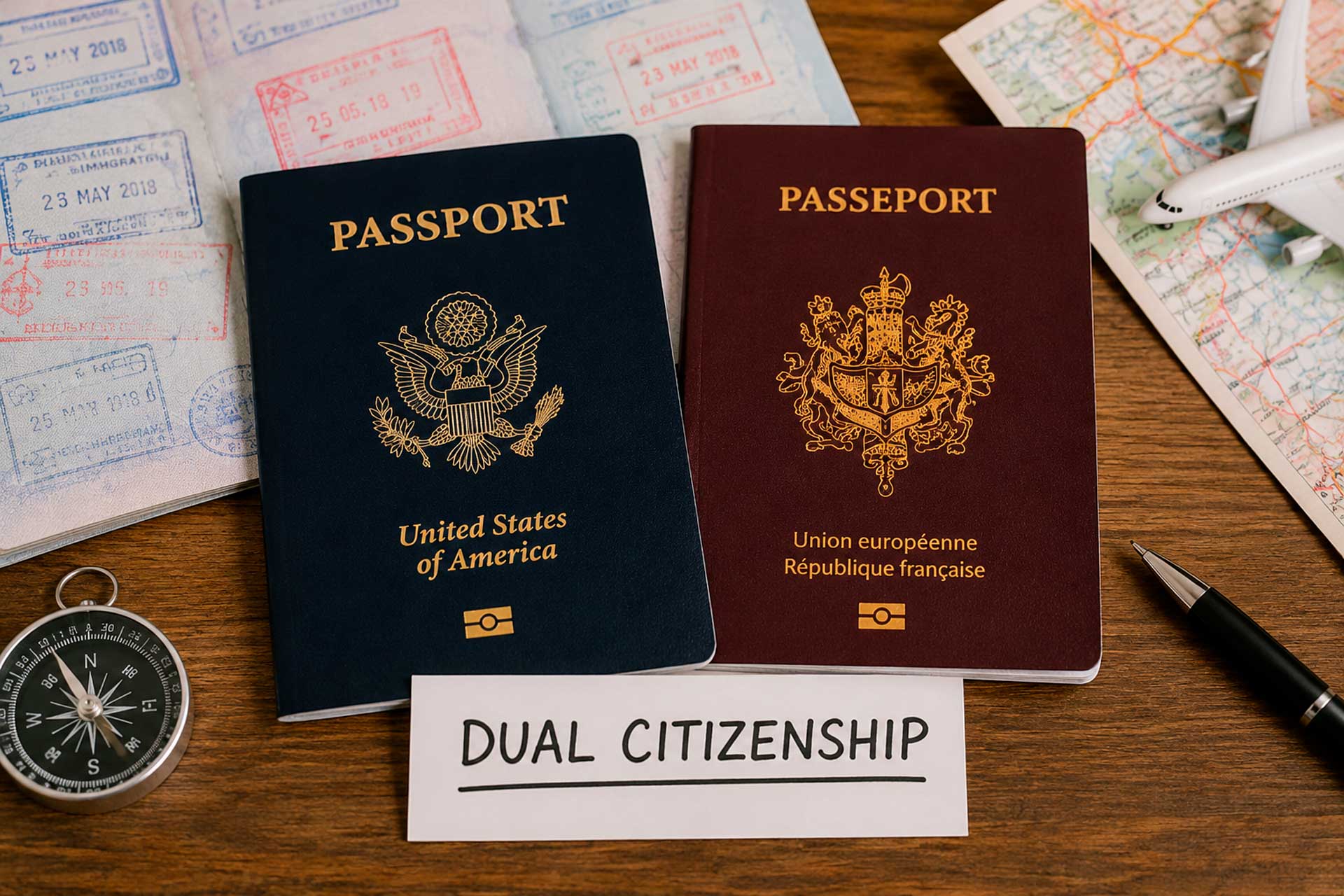
Simple definition: Dual citizenship means a person is treated as a citizen or national by two countries at the same time.
Official guidance does not use one universal label. The United States usually speaks about dual nationality, Canada uses dual citizenship, and the UK says dual nationality is “also known as dual citizenship.” In practice, these terms are often used interchangeably in public guidance. In stricter legal language, “nationality” usually describes the legal bond to a state, while “citizenship” often emphasizes the rights and duties that come with that bond.
Legally, dual citizenship exists because each country decides for itself who its citizens are. That is why the same person can be recognized by two states at once without filing a special “dual citizenship application.” Canada states this directly: if more than one country recognizes a person as a citizen, that person has dual citizenship.
Yes, a person can have more than two citizenships. The U.S. Department of State expressly notes that someone may hold more than two nationalities and that the same practical issues generally apply. For example, Elon Musk is a well-known example of a person with three citizenships. He was born in South Africa, obtained Canadian citizenship through his mother, and later became a naturalized U.S. citizen.
How Does Dual Citizenship Work
A dual citizen may hold two passports, vote where eligible, live or work in one or both countries, and pass citizenship to children if the relevant laws allow it. At the same time, that person may owe allegiance to both states and may need to obey both countries’ laws. U.S. guidance makes this point clearly: dual nationals owe allegiance to both countries and either country may enforce its laws against them.
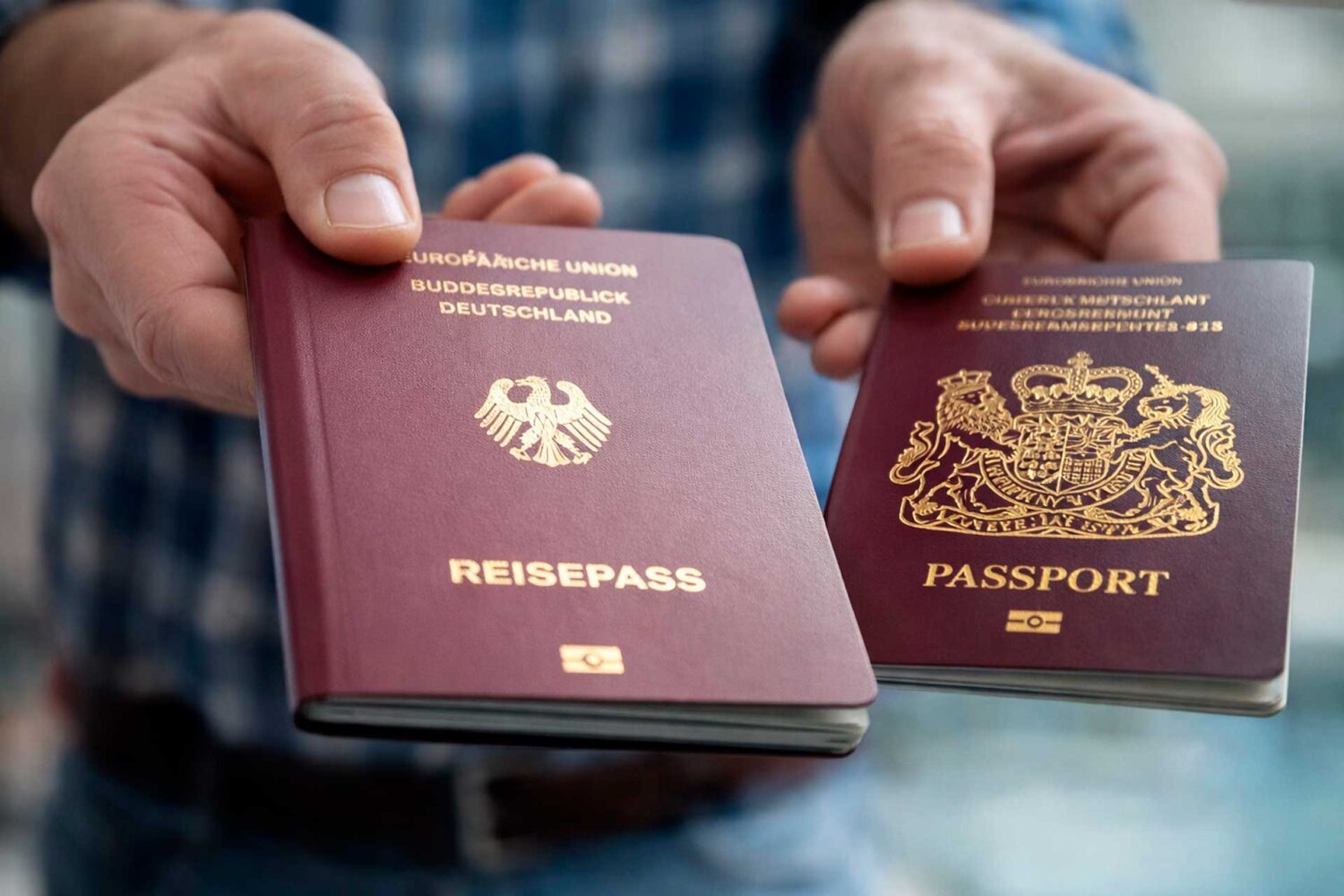
In travel practice, a dual citizen often uses different passports for different parts of one trip. The United States requires U.S. citizens, including dual nationals, to enter and leave the United States on a U.S. passport. Canada generally requires dual Canadian citizens boarding a flight to Canada to use a valid Canadian passport, although U.S.-Canadian dual citizens can enter Canada with a valid U.S. passport. The UK now requires British and Irish citizens, including dual citizens, to travel to the UK with a valid British passport or a certificate of entitlement in most ordinary cases.
Government recognition is the key issue. One country may fully accept dual citizenship, another may tolerate it but treat its own citizenship as dominant, and another may require a person to choose one nationality by a deadline. Japan’s Ministry of Justice says people with Japanese and foreign nationality must choose one nationality by a time limit and may lose Japanese nationality if they do not. Estonia remains restrictive as well: its Citizenship Act states that an Estonian citizen may not simultaneously hold another citizenship except under special rules, and minors with both citizenships must choose within three years after turning 18.
A practical rule follows from this: dual citizenship is not just about whether country A permits it. A person keeps both passports only if the laws of both countries permit, tolerate, or at least do not automatically cancel the other nationality.
Not sure if you qualify for dual citizenship? Leave a request for a consultation, and we’ll review your circumstances and recommend the most suitable path forward.
Schedule a free consultation and get detailed information from Unioncitizenship lawyers. Start the process today!

Ways to Obtain Dual Citizenship
By Birth
Birthright citizenship can arise from jus soli rules, jus sanguinis rules, or both. A child born in one country to a parent from another may be a citizen of both from day one. The U.S. Department of State gives this exact example: a child born abroad to U.S. citizen parents may be both a U.S. citizen and a citizen of the birth country. Italy also confirms that a child born to an Italian father or mother is an Italian citizen by birth under ius sanguinis.
The timeline is immediate. Typical requirements depend on local law: place of birth, parents’ citizenship, marital status rules, or proof of parentage. Common countries where birth plays a major role include the United States, Canada, Ireland, Italy, and Australia, though the exact scope differs country by country.
By Descent
Citizenship by descent is one of the most common routes for adults claiming a second passport later in life. The United States recognizes citizenship acquired at birth through a U.S. citizen parent under rules that depend on the law in force at the time of birth and the parent’s physical presence in the United States. Australia allows citizenship by descent if a parent was an Australian citizen at the time of birth.
Several European countries also offer citizenship by descent.
- Slovenia allows eligible individuals with Slovenian ancestry to apply for citizenship by descent, subject to the applicable legal requirements and supporting documentation.
- Romania permits many descendants of former Romanian citizens to reclaim or restore Romanian citizenship, including people whose ancestors lost citizenship due to historical border changes or other circumstances.
- Bulgaria also recognizes citizenship by descent, allowing applicants who can demonstrate Bulgarian origin through their ancestry to apply, provided they meet the relevant legal and documentary requirements.
- Italy’s rules remain descent-based, but its 2025 reform now imposes additional conditions for many applicants born abroad who already hold another citizenship. For post-reform applications, automatic transmission generally requires either a parent or grandparent who held only Italian citizenship, or a parent who lived in Italy for at least two continuous years before the applicant’s birth or adoption.
- Ireland allows claims through the Foreign Births Register for many people with an Irish-born grandparent.
The timeline varies. In some cases the citizenship exists automatically and the process is mainly documentary. In others, citizenship is granted only after registration or recognition. Typical requirements include birth certificates across generations, marriage records, name-change documents, proof that the ancestor did not lose citizenship before the next generation’s birth, and identity evidence.
By Marriage
Marriage rarely gives automatic citizenship today, but it often shortens the path. The UK is explicit that marriage to a British citizen does not automatically make someone British, but it creates a faster naturalization route. Ireland allows spouses or civil partners of Irish citizens to apply after three years of marriage and three years of reckonable residence on the island of Ireland. Italy allows an application after two years of legal residence in Italy after marriage, or three years after marriage if living abroad; those periods are halved if the couple has children.
This route usually requires proof of a valid marriage or civil partnership, genuine family life, residence history, language or civics compliance in some systems, clean criminal records, and continued marriage until the decision. It is common in the UK, Ireland, Italy, and the United States, where many spouses of U.S. citizens may naturalize after three years as permanent residents if other requirements are met.
By Naturalization
Naturalization is the standard route for long-term residents. In the United States, the most common path is five years as a lawful permanent resident. In Canada, most adults need 1,095 days of physical presence in the five years before applying. Germany’s 2024 reform reduced the regular residence period to five years and allows dual citizenship in principle. Australia’s conferral route is the common path for permanent residents, with residence requirements and a citizenship test or interview for many applicants. Estonia remains much stricter, generally requiring eight years of lawful residence, including the last five on a permanent basis, plus language, civics, income, and loyalty requirements.
Typical requirements are lawful residence, physical presence, good character, language and civics knowledge, stable income in some countries, and often a ceremony or oath. For many immigrants, this is the most realistic route to dual citizenship if the home country also allows them to keep original nationality.
By Investment
Citizenship by investment exists, but it is limited and highly regulated. St. Kitts and Nevis and Antigua and Barbuda operate official citizenship-by-investment programs through government units. St. Kitts and Nevis states that applicants can obtain citizenship through qualifying investments, and Antigua and Barbuda’s program is grounded in statute. Malta formerly administered citizenship by direct investment through its agency, but Malta announced in 2025 that the Granting of Citizenship for Exceptional Services programme had been discontinued.
The timeline is usually faster than residence-based naturalization. Typical requirements include source-of-funds checks, due diligence, clean criminal history, qualifying donations or real-estate purchases, and government fees. The main lesson for readers is practical: investment-based citizenship is real in some jurisdictions, but it is not a universal route, and the rules can change quickly.
Benefits and Drawbacks of Dual Citizenship
Dual citizenship can be genuinely useful:
- A second passport can widen visa-free travel options, reduce dependency on residence permits, and create a safety net if one country changes visa rules or political conditions.
- For families, it can ease relocation, education planning, inheritance, and the transfer of status to children.
- For EU citizenships in particular, nationality can unlock the right to live, work, and study across the Union.
It also has clear legal and economic advantages. Citizenship can improve property access where foreign ownership is restricted, allow direct access to local labor markets, widen business options, expand eligibility for public healthcare or education, and simplify family reunification where immigration law favors citizens over non-citizens. Political rights may also matter: some countries reserve voting and office-holding for citizens only. Canada’s Charter, for example, reserves federal, provincial, and territorial voting rights to citizens.
Yet the drawbacks are real and should not be minimized. Dual nationals may face conflicting laws, weaker consular help inside the other country of citizenship, military service obligations, travel-document rules, and extra financial reporting. The UK states plainly that a dual national cannot receive British diplomatic help while in the other country of citizenship. The U.S. Department of State warns that military service may be imposed by the other state and that consular access may be restricted when the other state treats the person only as its own citizen.
A balanced summary looks like this:
| Potential benefit | Why it matters | Potential drawback | Why it matters |
|---|---|---|---|
| Two passports | More travel options and backup identity documents. | Passport-use rules | Some countries require their own passport for entry or exit. |
| Live and work rights | Citizenship usually removes the need for work permits in that country. | Legal conflicts | Two states can impose different, even competing, duties. |
| Study and healthcare access | Citizens often get broader access to public systems and local tuition. | Admin burden | More forms, renewals, registrations, and evidence gathering. |
| Family strategy | Easier status planning for spouses and children in many systems. | Tax/reporting complexity | Especially serious for U.S. citizens abroad. |
| Political rights | Citizens may vote and sometimes run for office. | Security-clearance issues | Dual citizenship is not automatically disqualifying in the U.S., but it can trigger scrutiny. |
Top 8 Countries That Allow Dual Citizenship in 2026
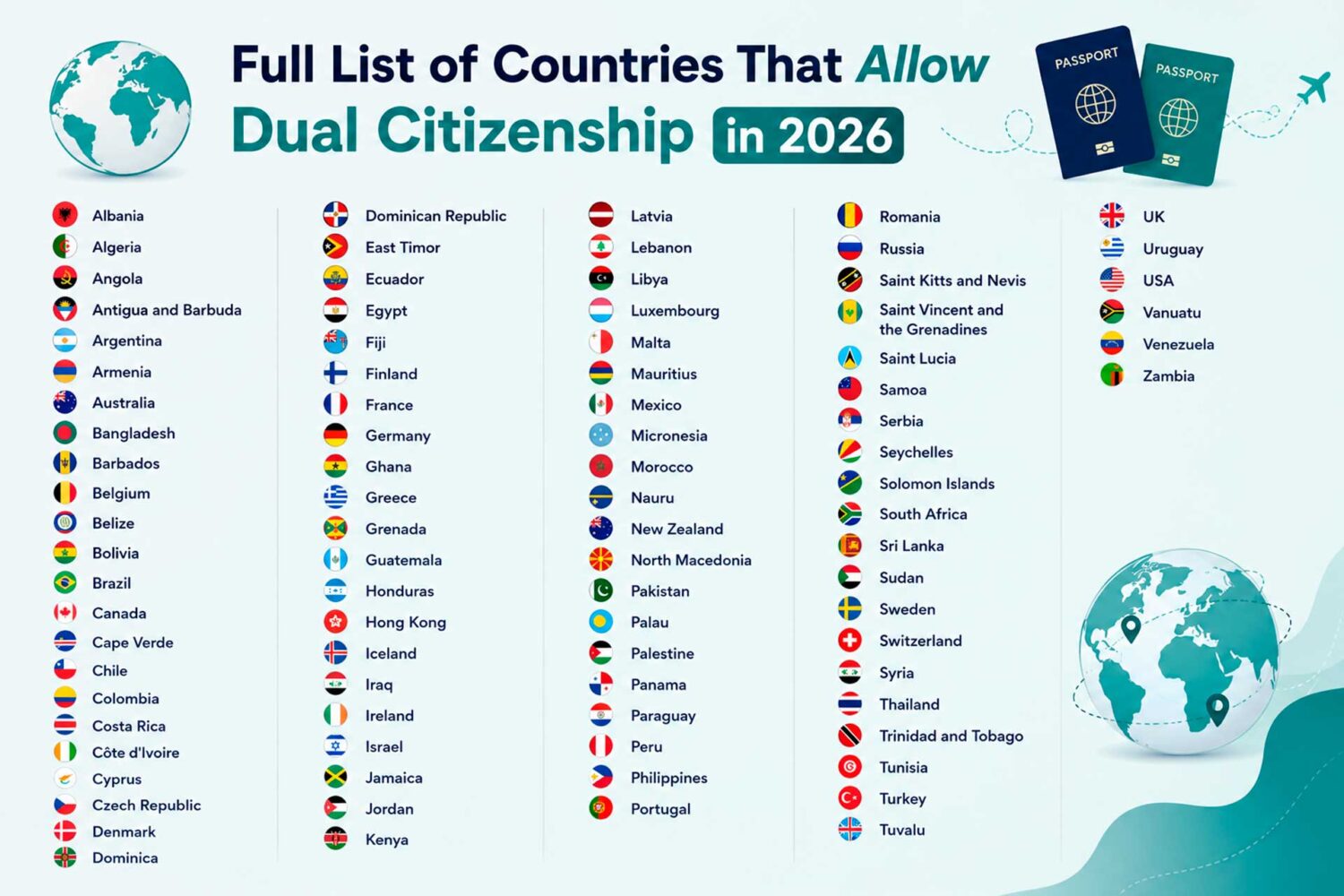
The table below summarizes the position of the Top 8 countries that allow dual citizenship in 2026. Rules can change, so always confirm the current position before applying.
| Country | Allows dual citizenship? | Key note |
|---|---|---|
| USA | Yes | The U.S. recognizes dual nationality in practice, but U.S. citizens must use a U.S. passport to enter and leave the United States. |
| Canada | Yes | Canadians may keep foreign citizenship, and dual citizenship does not require a separate certificate. |
| UK | Yes | The UK allows dual citizenship and lets British nationals hold a British passport. |
| Ireland | Yes | Ireland allows dual citizenship. |
| Italy | Yes | Italy recognizes multiple citizenship, and foreign citizenship does not by itself cause automatic loss of Italian citizenship. |
| Germany | Yes, generally | Since 27 June 2024, multiple citizenship is generally accepted. |
| Australia | Yes | Australia recognizes dual citizens and provides citizenship by descent and conferral routes. |
| Poland | Yes, with Polish priority | Multiple citizenship is admissible, but Polish citizenship takes precedence before Polish authorities. |
USA
The United States allows dual nationality in practice. A person may become a U.S. citizen by birth, acquire citizenship through a U.S. citizen parent, or naturalize later. The ordinary naturalization route is five years as a lawful permanent resident, while many spouses of U.S. citizens can apply after three years under the special spousal rules. An important exception is travel: U.S. dual nationals must use a U.S. passport to enter and leave the United States.
Canada
Canada fully permits dual citizenship. A person can qualify by birth, by descent, or by naturalization. The standard naturalization threshold is 1,095 days of physical presence in the five years before applying. Canada changed its descent rules in December 2025, removing the old first-generation limit in some situations and allowing transmission beyond the first generation where the Canadian parent can show three years in Canada before the child’s birth or adoption. Dual citizens travelling to Canada generally need a Canadian passport for air travel, although American-Canadian dual citizens may enter with a valid U.S. passport.
UK
The UK allows dual citizenship. British citizenship may arise automatically in some birth and descent cases or later through registration or naturalization. For many adults, the ordinary naturalization route is five years’ lawful residence, or three years if married to a British citizen. Marriage does not grant British citizenship automatically. Since 2026 travel-rule enforcement changes, dual British citizens are expected to travel to the UK with a valid British passport or certificate of entitlement in most cases.
Ireland
Ireland allows dual citizenship and is especially known for descent-based claims. Many people with an Irish-born grandparent can claim citizenship through the Foreign Births Register. For naturalization, most adults need five years of reckonable residence out of the last nine, including one continuous year immediately before the application. Spouses and civil partners of Irish citizens can often apply after three years of marriage and three years of reckonable residence on the island of Ireland.
Italy
Italy allows multiple citizenship and does not automatically cancel Italian citizenship when an Italian acquires another nationality. Qualification may come through descent, marriage, or residence. Italy remains one of the most significant descent-based systems, but its 2025 reform introduced tighter conditions for many applicants born abroad who already hold another citizenship. For spouses, the classic timetable remains two years of legal residence in Italy after marriage or three years if residing abroad, with the period halved if the couple has children. For residence-based naturalization, non-EU foreigners commonly need ten years of legal residence in Italy.
Germany
Germany’s position changed materially in 2024. Multiple citizenship is now generally accepted, and the standard residence period for naturalization was reduced from eight years to five years, with possible acceleration to three years for especially well-integrated applicants. The reform also tightened expectations around constitutional loyalty and social integration. For many immigrants, Germany moved from a classic “renounce first” model to a much more dual-citizenship-friendly system.
Australia
Australia recognizes dual citizenship and offers several acquisition routes, especially citizenship by descent and citizenship by conferral. A person born abroad may qualify by descent if one parent was an Australian citizen at the time of birth. For many permanent residents, conferral is the usual route; applicants must be permanent residents and meet residence, character, and knowledge requirements, with a test or interview for many adults. Australia also expects dual citizens to travel with appropriate Australian documentation when returning as citizens.
Poland
Poland permits multiple citizenship in practice, but Polish citizenship takes precedence in dealings with Polish authorities. That means a person may keep another nationality, yet Poland can still treat that person simply as Polish inside Poland. Qualification can arise by descent, presidential grant, or formal recognition as a Polish citizen. One widely used route is recognition after residence, where several residence patterns can qualify; a common example is two years of legal residence on a permanent or EU long-term permit combined with three years of marriage to a Polish citizen, or ten years of legal residence with stable income and housing. A B1-level Polish language certificate is required for recognition.

Taxes and Travel With Dual Citizenship
Citizenship and taxes are not the same thing. In most countries, tax liability depends primarily on tax residency, not on how many passports a person has. The OECD explains tax residency rules as a jurisdiction-by-jurisdiction question under the systems that exchange information under CRS. That is why many dual citizens pay tax only where they live or where income arises, not in both passport countries.
The major exception is the United States. The IRS states that U.S. citizens and resident aliens abroad are taxed on worldwide income. Many U.S. dual citizens living abroad therefore still file U.S. tax returns even if they owe little or no U.S. tax after credits or exclusions. Relief often comes through the Foreign Tax Credit, tax treaties, and the Foreign Earned Income Exclusion, but those tools reduce double taxation risk more than they remove filing obligations. For tax year 2026, the IRS says the maximum foreign earned income exclusion is $132,900 per qualifying person.
Reporting rules matter almost as much as tax itself. Under FATCA, certain U.S. taxpayers with foreign financial assets must report them to the IRS on Form 8938, subject to threshold rules. Separately, the FBAR must be filed when a U.S. person has foreign financial accounts whose aggregate value exceeds $10,000 at any time during the year. At a global level, CRS requires participating jurisdictions to collect and automatically exchange financial account information each year. For a dual citizen with accounts in several countries, this means banks and tax authorities may already be sharing the relevant data.
Travel with dual citizenship is simpler when the person thinks in “entry rules,” not just “visa-free access.” The safest pattern is to use the passport of the country one is entering if that country expects its own citizens to do so. The United States requires this. Canada generally expects it for dual Canadian citizens travelling by air, with special treatment for U.S.-Canadian dual citizens. The UK has moved in the same practical direction for British dual citizens. Passport validity also matters, because many carriers will deny boarding before any border officer reviews the case.
Would you like to learn more about dual citizenship and whether you qualify? Leave a request for a consultation, and our specialists will assess your case and explain your available options.
Schedule a free consultation and get detailed information from Unioncitizenship lawyers. Start the process today!

Can You Lose Dual Citizenship and Is It Worth It
Dual citizenship is not always permanent. It can end through renunciation, revocation, or automatic loss under some national laws. The U.S. allows people to relinquish nationality abroad through a formal process. Canada provides a renunciation route for people who no longer want to remain Canadian or who cannot be dual citizens under their other country’s law. Italy allows renunciation if the person has another citizenship and resides abroad. Ireland may revoke naturalized citizenship in certain circumstances, and Estonia and Japan still maintain systems where holding another citizenship can trigger a forced choice or loss risk.
Fraud is another major risk. Countries can revoke citizenship obtained through false documents, concealment, or misrepresentation. Australia’s official forms warn that fraudulent or misleading information can lead to refusal, prosecution, and possible revocation even after citizenship is granted. Similar fraud-based revocation principles exist in many systems.
A useful way to judge value is to compare dual citizenship with permanent residence:
| Factor | Dual citizenship | Permanent residency |
|---|---|---|
| Right to remain | Usually stronger and harder to lose than PR. | Strong, but can be lost, abandoned, or revoked in many systems. |
| Passport | Yes, usually. | No national passport. |
| Voting rights | Often yes, depending on country. | Usually no national voting rights. |
| Work rights | Full citizen labor-market rights. | Usually broad local work rights, but not the same political status. |
| International mobility | Depends on passport strength and entry rules. | Depends on PR card plus nationality passport; re-entry can be more complex. |
| Loss risk | Lower if citizenship is by birth; higher if obtained by fraud or if local law requires a choice. | Can be lost through absence, abandonment, removal, or naturalization elsewhere. |
For many people, dual citizenship is worth it when it solves a real life problem: family unity, long-term mobility, children’s status, retirement planning, or political belonging. It is less attractive when the second country imposes hard tax, military, or disclosure burdens and the person will rarely use the status. The best choice is practical, not emotional: compare concrete rights against concrete obligations.
For readers considering a second passport, the safest next step is to map the case against both countries’ laws, confirm tax exposure before filing anything, and check travel-document rules before the first trip after approval. Done carefully, dual citizenship can be one of the most valuable long-term immigration decisions a person or family makes.
If you’re unsure whether you qualify or want professional guidance through the process, leave a request for a consultation. Our immigration specialists can assess your eligibility, explain your available options, and help you prepare a clear strategy for obtaining a second citizenship.



Find out details about obtaining an EU passport at a free consultation
Fill out a simple form and an immigration lawyer will contact you shortly.