


Tax-Free Countries in 2026: a Global Overview

- What no income tax really means
- Comparison table of major no-income-tax jurisdictions
- How the landscape changed
- What expatriates still have to do
- Pros, cons and common pitfalls
- Checklist and advisory
As of 2026, the cleanest full zero personal-income-tax jurisdictions relevant to expatriates are the UAE, Bahrain, Kuwait, the Bahamas, Bermuda, Cayman Islands, Monaco, Brunei, and, based on the current official tax architecture, Vanuatu. But even these places are not tax-free in the ordinary sense: most rely on VAT/GST, customs duties, stamp duties, payroll taxes, work-permit fees, tourism charges, sectoral levies, or corporate taxes.
The category also needs important exclusions and caveats. Qatar and Saudi Arabia are better described as salary-tax-free rather than universally personal-income-tax-free, because their tax laws can still reach certain Qatar-source or Saudi-source business income. Oman is no longer a stable long-term “no income tax” case: Royal Decree 56/2025 introduced a 5% personal income tax, with effect from the start of 2028, and a high exemption threshold of OMR 42,000, which the Omani Tax Authority says leaves about 99% of the population outside the charge.
The bigger structural change since 2018 has not been the creation of wage taxes. It has been the spread of indirect taxes and OECD Pillar Two-style minimum taxes. The UAE now has 5% VAT, federal corporate tax, and a Domestic Minimum Top-up Tax from financial years starting on or after 1 January 2025. Bahrain raised VAT to 10% and also implemented a DMTT from 1 January 2025. Bermuda enacted a 15% corporate income tax for in-scope multinational groups, effective in 2025. Kuwait also moved to a DMTT for financial years beginning on or after 1 January 2025. In other words, the modern zero-PIT story is increasingly about where governments moved the tax burden, not whether they tax at all. So the real question is never just “Is income tax zero?” but rather “What taxes and fees replace it, and what still follows me from home?”
For expatriates, the decisive issues are usually not the local headline rate but tax residency, treaty access, home-country reporting, and banking compliance. U.S. citizens, for example, remain taxable on worldwide income and may need to rely on the foreign earned income exclusion rather than foreign tax credits if they move to a zero-tax jurisdiction. FATCA and CRS also mean foreign banks will usually ask for tax self-certifications and may report account information cross-border.
What no income tax really means
A rigorous way to read the phrase is to divide jurisdictions into three groups.
- The first group is full zero PIT: there is no broad national tax on salaries or ordinary personal income. The UAE is the clearest official example: the UAE government states that it does not levy income tax on individuals, while still levying 5% VAT, excise, and corporate tax on businesses. Bermuda also makes the distinction explicitly: individuals do not pay personal income tax, but Bermuda still levies a payroll tax. Cayman goes further and states that there are no direct taxes, including no income tax, company tax, inheritance tax, capital gains tax, or gift tax.
- The second group is partial or source-based cases. Qatar’s law expressly exempts salaries, wages, allowances and their equivalents, but the General Tax Authority also states that Qatar-source income earned by individuals is generally subject to 10% income tax. Saudi Arabia works in a similar way: it is commonly marketed as tax-free for salary earners, but the official income-tax framework applies to non-resident persons and to business activities and Saudi-source income in defined cases. These are not false “no tax” stories, but they are often overstated in relocation marketing.
- The third group is transitioning or unstable zero-PIT cases. Oman is the clearest example in 2026. It still functions as a no-PIT jurisdiction for now, but that is no longer a durable planning assumption because the new 5% PIT was enacted in 2025 and is due to enter into force in 2028. Anyone building a multi-year residence or employment plan around Oman should therefore model both the pre-2028 and post-2028 outcomes.
Finally, this report deliberately does not treat a territorial system or a special exemption regime as the same thing as a true zero-PIT jurisdiction. A country that taxes domestic-source income but exempts foreign-source income is offering a different legal model from a country that simply has no broad personal income tax at all. That distinction matters for treaty use, payroll structuring, and home-country compliance. This is an analytical distinction drawn from the official tax-law structures summarized above.
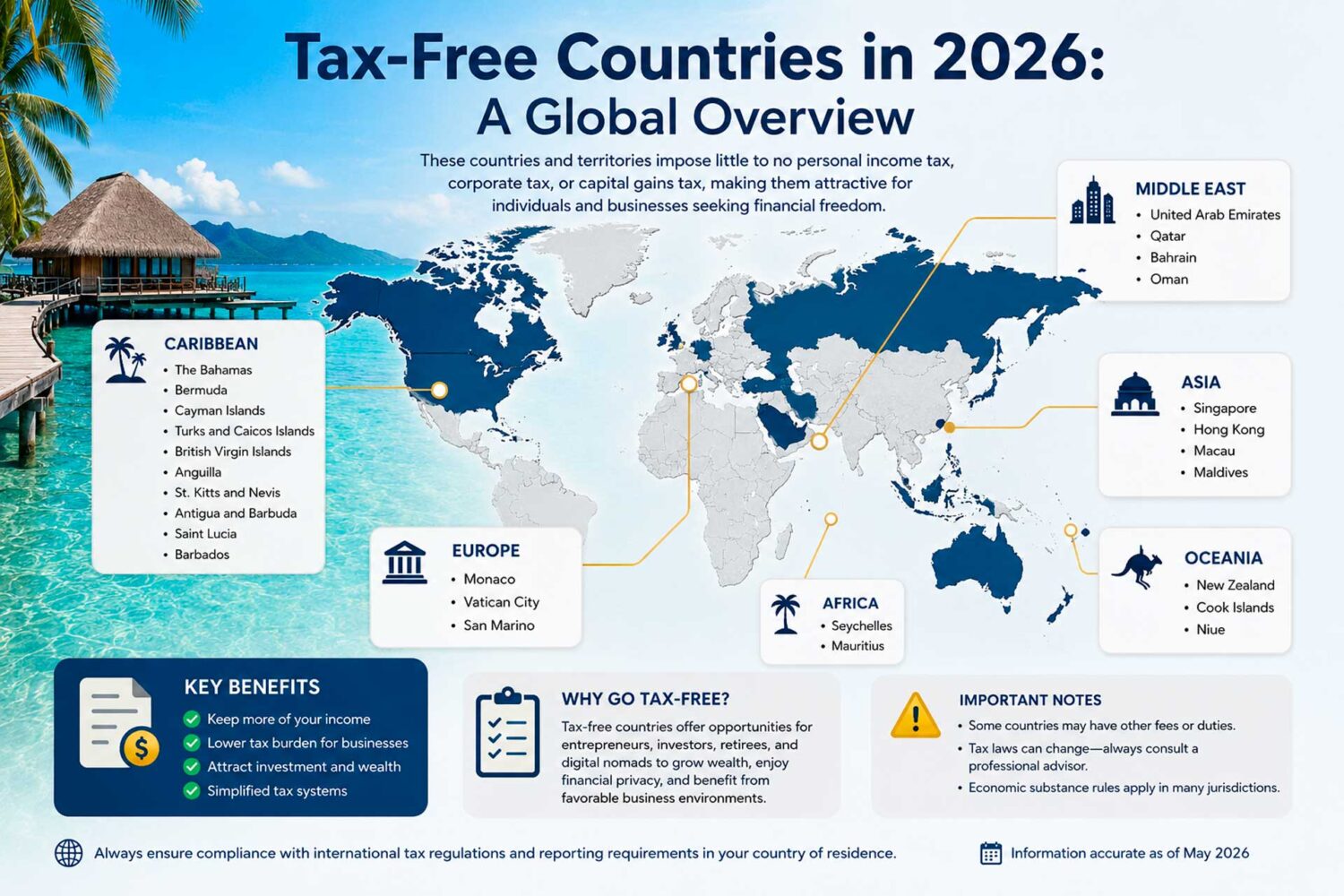
Comparison table of major no-income-tax jurisdictions
The table below focuses on the main jurisdictions most commonly discussed by expatriates and internationally mobile business owners. It is not every territory on earth that is sometimes marketed as “tax-free”; it is the list most relevant for serious residence and relocation planning.
| Jurisdiction | Status in 2026 | What the tax picture really looks like | Typical expat access | Recent change risk |
|---|---|---|---|---|
| UAE | Full zero PIT | No individual income tax; 5% VAT; federal corporate tax exists; DMTT effective for FYs starting on or after 1 Jan 2025. | Employment, family, and long-term residence routes including Golden Residency. | Material tax broadening since 2023, but still no wage tax. |
| Bahrain | Full zero PIT | No personal income tax; most businesses face 0% corporate tax except oil and gas; VAT 10%; DMTT effective 1 Jan 2025. | Work/family residence, plus Golden Residency. | VAT is no longer trivial, and Pillar Two now matters. |
| Kuwait | Full zero PIT | KDIPA describes Kuwait as having no personal income tax; foreign corporate income tax law remains; Kuwait has also moved to DMTT for FYs beginning on or after 1 Jan 2025. | Mainly employment-led residence; tax-administration systems also provide tax-residency certification services. | Main change is Pillar Two, not wage taxation. |
| Qatar | Partial / source-based | Salaries and wages are exempt, but the GTA states that Qatar-source income earned by individuals is generally taxed at 10%; VAT was still not implemented at the time of the latest reviewed guidance. | Most expat residence remains employment-linked in practice; tax administration infrastructure is well developed. | Often misdescribed as a total zero-PIT jurisdiction. |
| Saudi Arabia | Partial / source-based | Official income-tax rules can apply to relevant non-Saudi persons and business activities or Saudi-source income; the zero-tax narrative is strongest for ordinary salary earners, not for every individual-income scenario. | Premium Residency products exist alongside standard work residence. | Requires careful case-by-case source and business analysis. |
| Oman | Transitioning away from zero PIT | Oman enacted a 5% PIT in 2025, effective from the start of 2028, with a threshold of OMR 42,000 and substantial exemptions. | Residence and tax-residency certificate systems exist; current planning must distinguish pre-2028 from post-2028. | High medium-term change risk; do not treat as permanently tax-free. |
| Bermuda | Full zero PIT, but payroll-tax model | Government states individuals do not pay personal income tax; instead Bermuda levies payroll tax. Bermuda also introduced a corporate income tax for in-scope multinational groups. | Residence routes exist, but the former Work From Bermuda program closed to new applications in 2025; PRC routes remain. | Major shift: no PIT remained, but corporate tax arrived in 2025. |
| The Bahamas | Practical full zero PIT | The current official tax architecture centers on VAT, business licence, real property tax, and DMTT administration rather than a general PIT. VAT’s standard rate is 10%. | Residence permits and permanent residence are available through immigration processes. | Still marketed as tax-free, but indirect tax and property tax exposure can be meaningful. |
| Cayman Islands | Full zero PIT | Cayman states there are no direct taxes: no income tax, corporation tax, inheritance tax, capital gains tax, or gift tax. Revenue instead comes from import duty, stamp duty, work-permit and residency fees, tourism charges, and extensive business/financial-services fees. | Work, investor and permanent-residence routes exist; 2026 immigration reform tightened some investment-based requirements. | Excellent for pure local PIT planning, but not remotely “tax-free” in the broad sense. |
| Monaco | Full zero PIT with a major nationality exception | Monaco states that nationals and residents are not liable to income tax except French nationals subject to the 1963 bilateral convention framework. | Residence requires a permit; official materials emphasize accommodation and proof of means such as a Monaco bank reference or proof of support. | Legally stable but expensive and document-heavy; French-tax exposure is the classic trap. |
| Vanuatu | Practical full zero PIT | Current official revenue materials focus on VAT 15%, rent tax, business licensing and related taxes rather than a general PIT. | Residence visas include employee, self-funded resident and investor-related routes. | The core issue is usually immigration/banking practicality, not local PIT. |
| Brunei | Full zero PIT in practice for individuals | Brunei’s MOFE states corporate income tax applies to corporations, while the provisions do not take effect in respect of the incomes of other persons or bodies of person; the corporate rate is 18.5% for the relevant company category. | Residence for foreigners is mainly work-pass based. | Generally stable, but the residence market is much narrower than in the Gulf or Caribbean finance hubs. |
How the landscape changed
The headline shift since 2018 is that “no income tax” jurisdictions have increasingly added indirect taxes, corporate taxes, or OECD-style minimum taxes without touching ordinary wage income. The UAE added VAT in 2018, later implemented corporate tax, and then adopted a DMTT from 2025. Bahrain introduced VAT in 2019, then raised it to 10% in 2022, and later added a DMTT from 2025. Bermuda introduced a corporate income tax for in-scope MNE groups from 2025. Oman enacted a PIT law in 2025, with 2028 commencement. Kuwait also joined the DMTT trend from 2025.
A useful way to understand the policy reality is to look at how one classic no-PIT jurisdiction actually raises money. The Cayman Islands officially report that 2026 operating revenue should be about $1.26 billion, with $1.2 billion classified as coercive revenue, and the official detailed budget tables show large projected revenue lines from Other Import Duty, Stamp Duty – Land Transfers, Work Permit Fees, Partnership Fees, Other Company Fees – Exempt, Mutual Fund Administrators, and other financial-services or residency-related charges.
The practical conclusion is simple: a zero-PIT label often tells you how labour income is treated, but not how the state finances itself. In many of these jurisdictions, the tax burden reappears through consumption taxes, border taxes, regulated-market fees, and property-transfer charges, or at the corporate level through OECD-aligned minimum taxation.
Choosing a country with no income tax is about much more than a 0% tax rate. Residency requirements, indirect taxes, cost of living, business regulations, and long-term immigration opportunities can significantly affect the overall benefits. Leave a request for a personal consultation, and our specialists will help you compare the available options and select the most suitable jurisdiction for your lifestyle, business goals, and tax-planning needs.
Schedule a free consultation and get detailed information from Unioncitizenship lawyers. Start the process today!

What expatriates still have to do
Prove tax residence rather than assume it
In real life, a no-tax move only works if you can prove where you live and where you are tax resident. The official systems in the UAE, Bahrain, Kuwait, Oman, and Monaco all show the same basic pattern: authorities expect immigration status, accommodation evidence, identity documents, and often proof of means or compliance with local tax rules before they issue residence or tax-residency evidence. Monaco’s official process is especially clear on proof of means and accommodation; the UAE confirms that a tax residency certificate is used to benefit from double-tax treaties; Bahrain, Kuwait, and Oman all maintain formal tax-residency certificate channels.
That means a visa alone is rarely enough for serious tax planning. As a practical matter, you usually need a measurable documentary trail: days in country, lease or title deed, payroll or business records, bank and utility evidence, and formal tax-residency documentation where available. This is an evidence-based inference from the official certificate and residency processes above.
Check treaty access and home-country exit rules
A second common mistake is assuming that moving to a no-PIT jurisdiction automatically ends taxation elsewhere. It often does not. Treaty access varies widely, and the practical value of a treaty may be limited if the new state does not actually impose a tax that can be credited. The UAE explicitly links its tax-residency certificate to the use of double-tax agreements, and Bahrain, Kuwait, and Oman also maintain treaty/tax-residency infrastructure. But that does not override your home-country residence rules, economic-ties tests, or exit provisions.
The most important planning inference is this: if you move from a high-tax country to a zero-tax country, your foreign tax credit position may weaken precisely because you are no longer paying significant foreign income tax. In those cases, the planning burden shifts toward residence tests, treaty tie-breakers, domestic exemptions, and timing rather than simple credits.
Remember that U.S. citizens do not become tax-free abroad
For U.S. citizens and resident aliens, there is no “move to Dubai and stop filing” rule. The IRS states that U.S. citizens and resident aliens abroad remain taxable on worldwide income and must keep filing. Some may qualify for the foreign earned income exclusion, which the IRS says is $132,900 for tax year 2026, but relief depends on meeting the legal tests and filing correctly.
This is why U.S. persons often feel less benefit from a zero-tax move than non-U.S. expatriates. If the host country imposes no income tax, the taxpayer may have little or no foreign income tax to credit against U.S. liability, so the result hinges heavily on exclusions, deductions, sourcing, housing treatment, and structuring. That is an inference from the official IRS framework rather than a universal outcome.

Expect FATCA and CRS bank reporting
Banking compliance is another recurring surprise. The OECD’s CRS by jurisdiction portal and CRS standard make clear that many jurisdictions exchange financial-account information automatically. The IRS separately explains FATCA reporting for U.S. taxpayers and financial institutions. In practice, this means banks in many zero-tax jurisdictions will still ask you for tax identification details, self-certification, and reporting declarations, and the information may move back to the authorities in your home country.
A zero-income-tax jurisdiction, therefore, is not a secrecy jurisdiction by default. From a compliance perspective, it is usually a high-documentation environment, not a low-documentation one.
Pros, cons and common pitfalls
The main advantages are real. A genuine zero-PIT jurisdiction can materially increase net compensation, simplify local payroll for individuals, and make internationally mobile work or investment structures more flexible. Jurisdictions such as the UAE, Bahrain, Cayman, Monaco, and Bermuda remain attractive precisely because they combine this with deep business infrastructure or established wealth, tourism, or financial-services ecosystems.
The disadvantages are equally real. First, many of these jurisdictions are expensive in practice, especially where housing is scarce or imported goods dominate. Second, the tax burden is often shifted to VAT, customs, stamp duty, payroll tax, tourism taxes, work-permit fees, and regulated-market charges. Third, some of the most publicized jurisdictions now have more corporate taxation than many relocation blogs admit.
The most common pitfalls are predictable. People assume that:
- a residence permit automatically makes them tax resident;
- a zero local wage-tax rate eliminates their home-country filing;
- “no income tax” means “no tax at all”;
- Qatar and Saudi Arabia are always full zero-PIT cases;
- Oman is still a permanent member of the no-PIT club;
- Monaco is universally tax-free, including for French nationals.
For serious planning, the correct approach is to ask four questions in order: What local taxes still apply? What is my immigration route? How do I prove tax residence? What continues to apply from home? Those four questions usually do more real work than the headline rate. This is a planning synthesis drawn from the official sources throughout this report.
The best no-income-tax country is not necessarily the one with the lowest tax rate, but the one that matches your residency goals, lifestyle, business activities, and long-term plans. Leave a request for a personal consultation, and our specialists will help you evaluate your options, compare jurisdictions, and choose the most advantageous solution for your situation.
Schedule a free consultation and get detailed information from Unioncitizenship lawyers. Start the process today!

Checklist and advisory
The official residence and tax-certificate procedures reviewed for Monaco, the UAE, Bahrain, Kuwait, Oman, the Bahamas and Cayman strongly suggest that a serious relocation file should be prepared as a document pack, not as a last-minute visa application.
Action checklist:
- Confirm whether your target jurisdiction is full zero PIT, partial/source-based, or transitioning.
- Map every other local impost that may replace PIT: VAT, customs, payroll tax, stamp duty, work-permit fees, property-transfer charges, corporate tax, DMTT.
- Choose the correct immigration route: employment, family, investor, golden/premium, or independent-means.
- Build a tax-residency evidence file: passport and immigration approvals, entry/exit records, lease, title deed, or certificate of accommodation, utility and municipal evidence where relevant, employment contract, business licence, or proof of professional activity, bank reference or proof of funds where the residence route requires it, local tax-residency certificate if available.
- Review your home-country residence rules, exit rules, and reporting obligations before the move date.
- If you are a U.S. person, model FEIE, FBAR/Form 8938, and any residual U.S. liability in advance.
- Prepare for CRS/FATCA onboarding questions from banks and investment platforms.
- If you use a company, review corporate tax, Pillar Two, and economic-substance implications separately from your personal move.
Core document pack
A practical starter file usually includes:
- passport copies for all family members,
- civil-status documents,
- police-clearance or health documents if the immigration route requires them,
- lease/title deed or accommodation certificate,
- proof of income, assets, or a bank reference,
- employer letter or incorporation documents,
- prior-year tax returns from home,
- travel logs,
- draft home-country deregistration or departure filings where needed.
This article focuses on the main jurisdictions most relevant to expatriates and internationally mobile professionals rather than every territory sometimes mentioned in “tax-free country” lists. In a few cases, especially Vanuatu and the Bahamas, official English-language materials define the current tax architecture clearly but do not always state in one single sentence that there is “no personal income tax”; the classification here is therefore based on the reviewed official tax structure rather than a single slogan. Cost of living was not benchmarked quantitatively across all jurisdictions here; in practice, that should be treated as a separate diligence exercise before any move.
If you are planning to relocate to a country with no income tax, success depends on much more than obtaining a residence permit. Tax residency rules, banking requirements, reporting obligations in your home country, business structures, and property ownership can all affect the final outcome. Leave a request for a personal consultation, and our specialists will help you assess the available options, avoid costly mistakes, and build the most effective relocation and tax-planning strategy for your goals.


Find out details about obtaining an EU passport at a free consultation
Fill out a simple form and an immigration lawyer will contact you shortly.