


Most Dangerous Countries in the World: 2026 Ranking
- Methodology and Limitations
- Top 25 Most Dangerous Countries (2026)
- Detailed Profiles of the Top 10 most dangerous countries in the world
- Why These Countries Are Dangerous
- Most Dangerous by Category
- Safer-Country Alternatives
- Travel Safety Tips
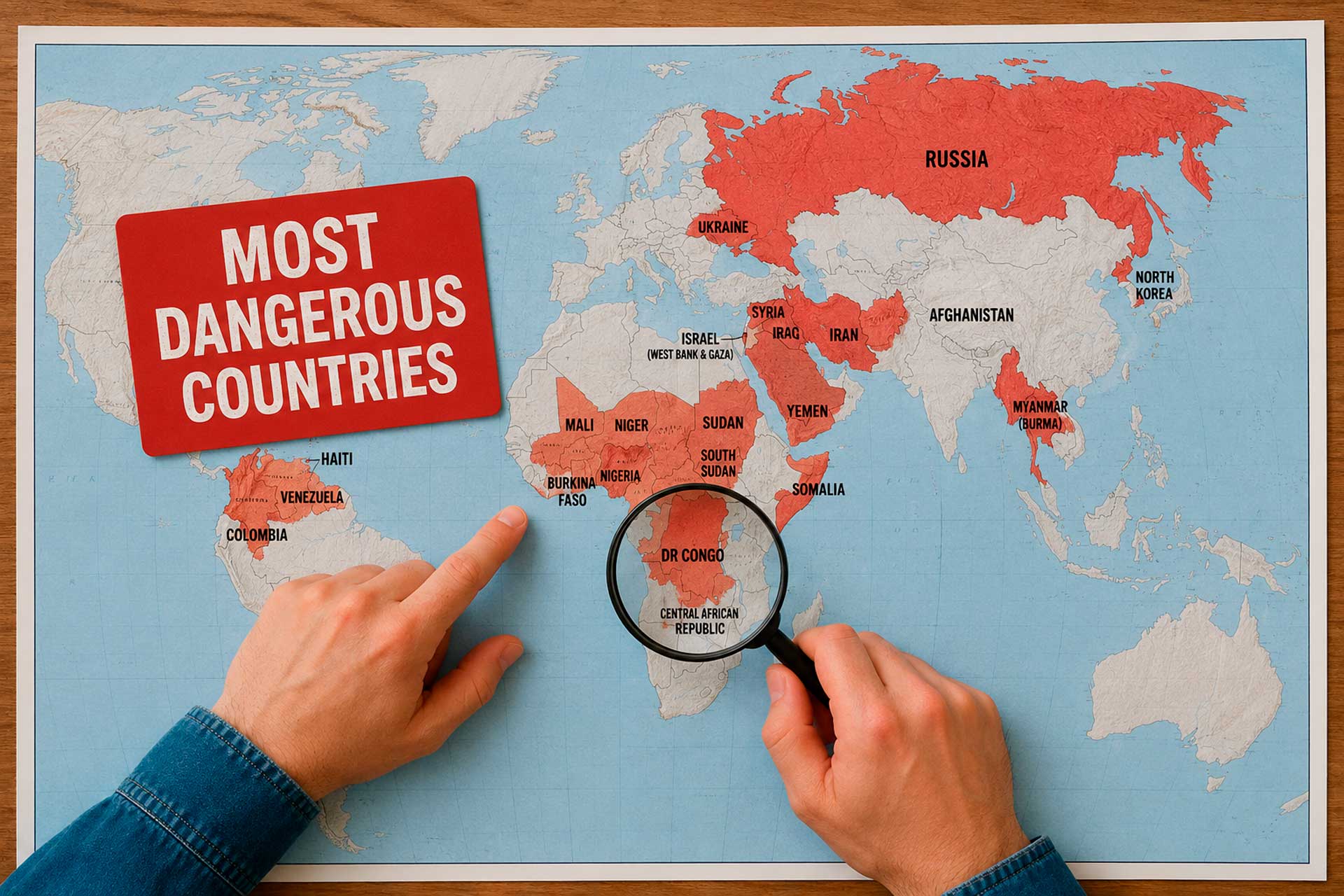
Global indices measure how “dangerous” a country is by factors like armed conflict, terrorism, high crime, political instability, and health crises. A country with ongoing war or high violence is typically labeled dangerous. According to the latest data, the top 10 most dangerous countries in 2026 are: 1. Russia; 2. Ukraine; 3. Sudan; 4. Democratic Republic of the Congo; 5. Yemen; 6. Afghanistan; 7. Syria; 8. South Sudan; 9. Israel; 10. Mali. These nations face severe security threats – from full-scale wars and terrorism to pervasive crime and health emergencies – and are generally under strict travel warnings. Most are rated “Level 4 – Do Not Travel” by agencies like the U.S. State Department.
In the Global Peace Index 2025, Russia ranked as the least peaceful country (driven by its war in Ukraine), followed closely by Ukraine, Sudan, the DRC, and Yemen. This reflects a historic low in global peace. For example, U.S. travel advisories bluntly warn: “Do not travel to Russia for any reason. U.S. citizens are at risk due to terrorism, unrest, wrongful detention, and other threats.”. Similarly, Afghanistan’s advisory states “Do not travel…due to civil unrest, crime, terrorism, wrongful detention, kidnapping, natural disasters, and limited health facilities.”. These official sources highlight how complex dangers (war, crime, natural hazards, poor governance) make a country “dangerous.” In summary, the top dangerous countries are those experiencing major wars, insurgencies, or societal collapse. The following sections (Table of Top 25, detailed country profiles, risk factors, category breakdowns, safer alternatives, tips, and FAQs) offer a comprehensive, data-driven overview with sources.
Methodology and Limitations
This ranking is based on a comprehensive review of the most authoritative global safety, conflict, and travel datasets available. Because there is no universally accepted measure of how “dangerous” a country is, we developed a comparative framework that evaluates multiple risk factors rather than relying on a single index.
Our analysis combines data from the Institute for Economics & Peace’s Global Peace Index (GPI) and Global Terrorism Index (GTI), United Nations conflict and humanitarian reports, World Health Organization (WHO) health risk assessments, World Bank governance and political stability indicators, ACLED (Armed Conflict Location & Event Data) conflict monitoring, Uppsala Conflict Data Program (UCDP), UN Office on Drugs and Crime (UNODC), and the latest official government travel advisories from countries such as the United States and the United Kingdom.
To create a consistent comparison across countries, we assessed several core risk categories, including:
- Armed conflict and war.
- Terrorism and insurgency.
- Violent crime and personal safety.
- Political instability and governance.
- Humanitarian and public health risks.
- Official travel advisory levels.
Countries that consistently ranked among the highest-risk nations across multiple independent datasets received higher overall risk scores. Rather than relying on any single source, this methodology emphasizes consensus across internationally recognized organizations, making the ranking more balanced and reliable.
Limitations
Although every effort has been made to use the most recent and credible information available (primarily from 2022–2026 publications and updates), no global ranking can capture rapidly changing conditions in real time. Conflict zones may have incomplete casualty reporting, crime statistics can vary in quality between countries, and official travel advisories are not always updated immediately following major events.
For these reasons, this ranking should be viewed as an evidence-based snapshot of global safety conditions rather than an absolute measure of risk. Security situations can change quickly due to political developments, natural disasters, ceasefires, or escalating conflicts. Whenever planning international travel or relocation, readers should always consult the latest official government travel advisories and local authorities before making decisions.
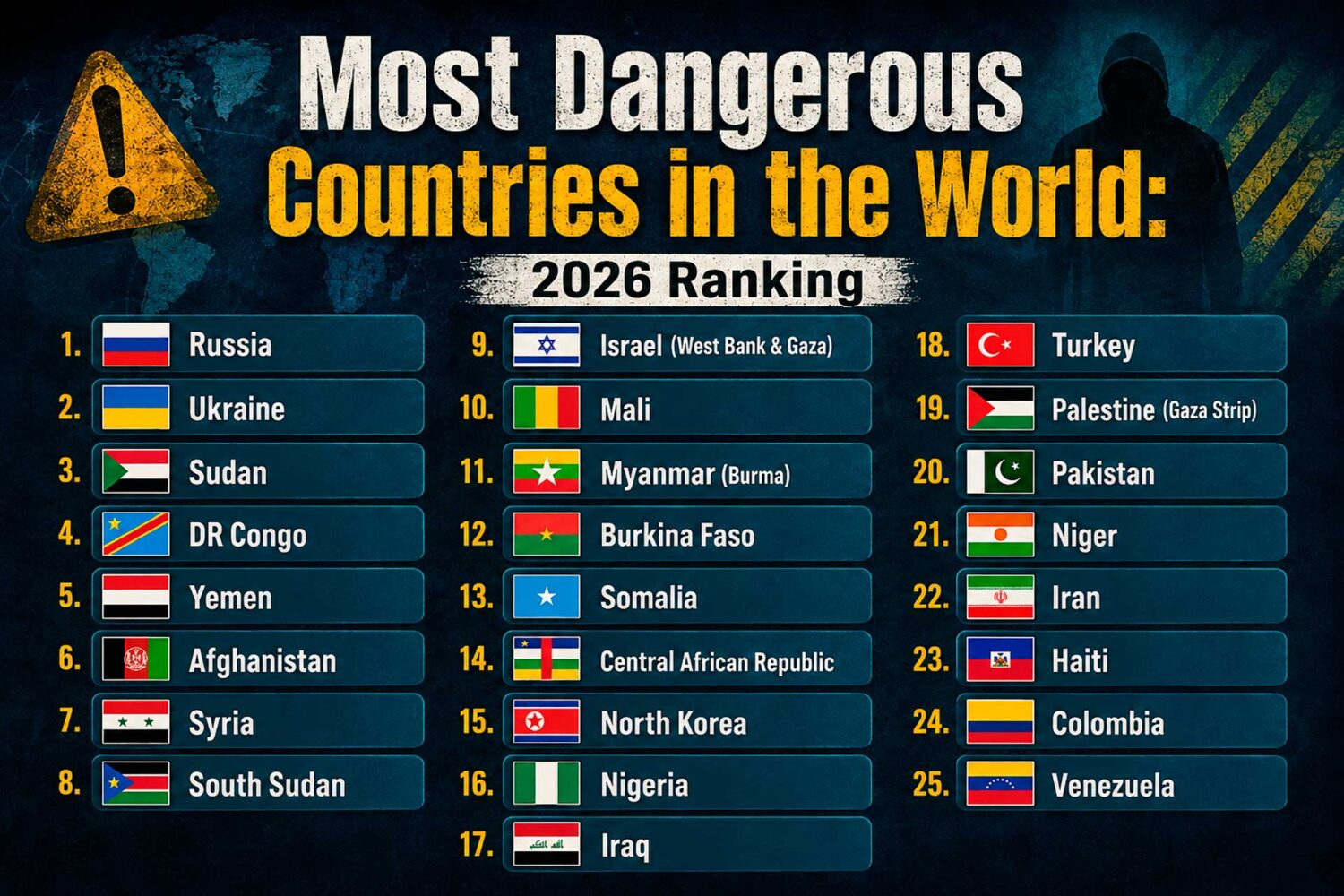
Top 25 Most Dangerous Countries (2026)
| Rank | Country | Risk Level | Main Risks | Safe for Tourists? |
|---|---|---|---|---|
| 1 | Russia | Extreme | War with Ukraine; terrorism; political repression | No (Level 4 travel advisory) |
| 2 | Ukraine | Extreme | Active war (Russian invasion); landmines; missile attacks | No (Level 4 travel advisory) |
| 3 | Sudan | Extreme | Civil war (RSF vs SAF); armed militias; landmines | No (Level 4 travel advisory) |
| 4 | DR Congo | Extreme | Multiple armed conflicts; Ebola outbreak (PHEIC); rebel violence; kidnapping | No (Level 4 – health/emergency advisory) |
| 5 | Yemen | Extreme | Civil war (Houthi vs Gov); terrorism (AQAP, ISIS); cholera; landmines | No (Level 4 – Do Not Travel) |
| 6 | Afghanistan | Extreme | Taliban rule; ISIS insurgency; kidnapping; earthquakes; limited health care | No (Level 4 – Do Not Travel) |
| 7 | Syria | Extreme | Civil war; regime terrorism; jihadi insurgents; infrastructure collapse | No (Level 4 – Do Not Travel) |
| 8 | South Sudan | Extreme | Ethnic violence; rebel warfare; widespread crime | No (Level 4 – Do Not Travel) |
| 9 | Israel (West Bank & Gaza) | Very High | Terrorism (Hamas, Hezbollah); armed conflict; rocket attacks | No/Conditional (Reconsider travel in Israel; Do Not Travel in Gaza) |
| 10 | Mali | Very High | Jihadist insurgency; coups; kidnapping; armed robbery | No (Level 4 – Do Not Travel) |
| 11 | Myanmar (Burma) | Very High | Ethnic insurgencies; military coup; protests and violence | No (severe unrest) |
| 12 | Burkina Faso | Very High | Jihadist attacks; kidnapping; instability | No (growing terrorism) |
| 13 | Somalia | High | Al-Shabaab terrorism; clan warfare; piracy | No (FCDO: “avoid all travel”) |
| 14 | Central African Republic | High | Rebel militia conflict; tribal violence; coup aftermath | No (civil unrest) |
| 15 | North Korea | High | Totalitarian regime; border skirmishes; armed forces | No (repressive state) |
| 16 | Nigeria | High | Boko Haram/ISWAP; bandit gangs kidnapping; crime | No (terrorism hotspots) |
| 17 | Iraq | High | ISIS remnants; sectarian violence; militia clashes | No (areas unstable) |
| 18 | Turkey | High | Terrorism (PKK/ISIS); regional instability; coups risk | No (Terrorism threat) |
| 19 | Palestine (Gaza Strip) | High | Warzone (Israel-Hamas conflict); terrorism | No (active war zone) |
| 20 | Pakistan | High | Terrorist attacks; sectarian strife; crime | No (ongoing terror threat) |
| 21 | Niger | High | Jihadist insurgency; border instability | No (Sahel conflict) |
| 22 | Iran | High | Regional proxy wars; human rights abuses | No (tension with West) |
| 23 | Haiti | High | Gang violence; political crisis; kidnappings | No (widespread crime) |
| 24 | Colombia | High | Guerrilla remnants (FARC dissidents); crime; kidnapping | Reconsider (some regions only) |
| 25 | Venezuela | High | Crime; political/economic collapse; organized militias | Reconsider (security issues) |
Risk Levels: “Extreme” = worst safety (top 10), “High” = severe risk, “Very High” one step below extreme. Main Risks summarize armed conflict, terrorism, crime and other factors (citing travel advisories). Safe for Tourists? notes travel advisories or general guidance (e.g. No if travel bans in place).
Detailed Profiles of the Top 10 most dangerous countries in the world
1. Russia
- Overall Safety: Very low. Russia scored ~3.44 in GPI 2025 (least peaceful).
- Why Dangerous: Full-scale war with Ukraine, aggressive military actions, and internal repression dominate. Recent conflicts (Donbas, Crimea) and sanctions have destabilized the region.
- Crime: Petty crime is moderate, but foreigners risk arbitrary detention. Military zones see rocket attacks (2024 Moscow Crocus City attack).
- Terrorism: Lone-actor and jihadi attacks occur inside Russia (e.g. Moscow theatre attack 2023). Near the Ukrainian border, drone/rocket incidents have been reported.
- Political Stability: Authoritarian crackdown; any dissent is harshly punished. Martial law declared in border regions (2022).
- Health Risks: Generally developed healthcare, but shortages exist in sanctioned sectors. Winter travel is harsh. No major epidemics reported, but any conflict injuries could overwhelm hospitals.
- Travel Advice: Do not travel. The U.S. State Dept: “Do not travel to Russia for any reason” due to terrorism, unrest, detention risk. Many governments advise against travel.
- Tourism: Not safe. Tourist infrastructure exists in major cities, but war and repression make any visit risky.
- Alternatives: Visit safer neighbors like Finland, Norway or safe parts of Eastern Europe for comparable cultural experiences.
2. Ukraine
- Overall Safety: Very low. GPI ~3.43 (2nd least peaceful).
- Why Dangerous: Ongoing invasion by Russia (since Feb 2022) means active frontlines, missile strikes and large-scale hostilities. Infrastructure is damaged across the country.
- Crime: Crime has risen due to lawlessness in occupied and conflict areas, but overall governance remains more intact than wartime chaos.
- Terrorism: War itself, plus reports of planted explosives and partisan activity; limited foreign terrorist activity.
- Political Stability: Government remains functional under wartime emergency. Large-scale mobilization and martial law are in effect.
- Health Risks: War injuries, destroyed hospitals in combat zones, shortages of medicine. Cold winter and electricity cuts compound civilian danger.
- Travel Advice: Do not travel. The U.S. State Dept explicitly lists Ukraine at Level 4 due to Russia’s war. Even safe cities face missile risk.
- Tourism: Essentially closed. Some western areas are tentatively open for humanitarian reasons only.
- Alternatives: Travelers should choose fully safe EU countries (e.g. Poland, Slovakia) for “Eastern Europe” travel instead.
3. Sudan
- Overall Safety: Very low. GPI ~3.32 (3rd least peaceful).
- Why Dangerous: Civil war (2023–) between the regular army and Rapid Support Forces has devastated cities like Khartoum. Government collapse and ethnic violence prevail.
- Crime: Armed robbery, assault and kidnapping are common nationwide. Checkpoints (many illegitimate) threaten travelers with theft or violence.
- Terrorism: Militant groups (Janjaweed remnants, Islamist radicals) operate especially in Darfur and Kordofan. Attacks on civilians continue even in ceasefire times.
- Political Stability: Government effectively collapsed; U.S. Embassy closed. Lawlessness prevails, with multiple armed factions fighting.
- Health Risks: Extremely limited medical care. Waterborne diseases, cholera and malaria are widespread. Landmines are a persistent hazard.
- Travel Advice: Do not travel. S. advisory warns of “unrest, crime, kidnapping, terrorism, landmines, and health threats”.
- Tourism: None – tourism infrastructure ceased in 2023.
- Alternatives: For visitors seeking African cultures, consider Egypt or Ethiopia (both relatively more stable, though always consult current advisories).
4. Democratic Republic of the Congo (DRC)
- Overall Safety: Very low. GPI ~3.29 (4th least peaceful).
- Why Dangerous: Multiple ongoing armed conflicts: ADF militants in the east, the M23 rebellion, and intercommunal violence. Eastern regions are active war zones.
- Crime: Armed robbery, assault, rape, and militia extortion are endemic. Kidnappings (often by rebels) occur regularly.
- Terrorism: Jihadist ADF cells linked to ISIS cause terror in eastern DRC. Foreign fighters and UN peacekeepers are targeted.
- Political Stability: Weak central authority. Government control is largely absent outside Kinshasa. Elections have been delayed; governance is fragile.
- Health Risks: DRC is battling Ebola outbreaks (declared Public Health Emergency) and has weak health infrastructure. Malaria and cholera are common.
- Travel Advice: Do not travel. The U.S. warns: “Do not travel to the DRC due to health, crime, unrest, terrorism, and kidnapping”, noting Ebola restrictions.
- Tourism: Only limited (e.g. some safaris with security). Most national parks closed due to rebel presence.
- Alternatives: Neighbors Uganda or Rwanda offer much safer alternatives for nature and cultural travel; they are stable and tourist-friendly.
5. Yemen
- Overall Safety: Very low. GPI ~3.26.
- Why Dangerous: Ongoing civil war (2015–) between Houthi rebels and the Saudi-backed government has flattened cities and crippled society. Infrastructure (housing, hospitals) is largely destroyed.
- Crime: Kidnappings and violent crime are rampant, especially outside main cities. Armed militias often act with impunity.
- Terrorism: Al-Qaeda in the Arabian Peninsula (AQAP) and ISIS-K continue to plan attacks. The U.S. has re-designated Yemen’s Houthi leaders as terrorists. Frequent suicide and drone attacks occur.
- Political Stability: Deeply divided – two rival administrations (Sanaa vs. Aden). No central authority can enforce law.
- Health Risks: Severe – collapsed health system. Cholera outbreaks, diphtheria, measles, polio are resurging. Food insecurity and COVID also pose threats.
- Travel Advice: Do not travel. S. travel advisory: “Do not travel…due to risk of terrorism, unrest, crime, health risks, kidnapping, and landmines”.
- Tourism: Virtually non-existent. Even UN staff evacuate regularly.
- Alternatives: Oman (neighbor) remains very safe and shares Yemeni culture without conflict. The UAE or Qatar are other regional substitutes with Yemeni diaspora communities.
6. Afghanistan
- Overall Safety: Very low. GPI ~3.23.
- Why Dangerous: Taliban rule and Islamic State insurgency make Afghanistan a war-torn society. Ordinary governance and services are nearly non-existent.
- Crime: Violent crime is common. Roadside bombs and suicide attacks target civilians and the Taliban alike. NGOs and NGOs workers are frequently harassed or detained.
- Terrorism: Several terror groups (ISIS-K, Taliban commanders, AQ) operate. Kabul and other cities suffer bombings.
- Political Stability: Single-party Taliban government lacking legitimacy. Regular clashes with IS and anti-Taliban factions (e.g. in Panjshir) continue.
- Health Risks: Poor – limited medical access, polio persists, and a 2025 earthquake killed 1,100 people. Famine and drought add risks.
- Travel Advice: Do not travel. All U.S. travelers are urged to leave immediately due to “civil unrest, crime, terrorism, wrongful detention, kidnapping, natural disasters, and limited health facilities”.
- Tourism: None – foreign tourism banned. Even humanitarian aid workers face dangers.
- Alternatives: The safest nearby travel options are countries like Uzbekistan or Tajikistan (much higher stability) for learning about Central Asian culture.
7. Syria
- Overall Safety: Very low. GPI ~3.18.
- Why Dangerous: A decade-long civil war (and Russian/Iranian intervention) has left Syria shattered. Large areas see active fighting or ISIS hideouts. The Assad government uses brutal tactics, including indiscriminate bombing.
- Crime: Kidnappings, looting and tribal feuds persist. Outside government areas, law is utter chaos.
- Terrorism: ISIS cells in the desert, Hezbollah and Iranian proxies, and ongoing insurgency in Idlib create constant terror threats. The entire country is effectively a warzone.
- Political Stability: Extremely low – divided territories (Assad regime, Turkish-backed rebels, Kurdish forces). Economy collapsed, massive refugee crisis.
- Health Risks: Healthcare infrastructure largely destroyed by bombardment. Disease and malnutrition are widespread. COVID-19 also hit poorly.
- Travel Advice: Do not travel. S. states: “Do not travel to Syria. There are serious risks of terrorism, unrest, kidnapping, hostage taking, crime, and armed conflict.”
- Tourism: Non-existent except for very limited humanitarian corridors. No tourism industry.
- Alternatives: Visitors might choose Jordan (for Middle Eastern culture and ancient sites) or Lebanon (before 2020), both now more stable (though Lebanon has its own unrest).
8. South Sudan
- Overall Safety: Very low. GPI ~3.09.
- Why Dangerous: Civil war between President Kiir and ex-Vice President Machar has resumed repeatedly (especially 2023). Tribal fighting and political breakdown are common.
- Crime: Violent crimes (carjackings, shootings, rape) occur even in Juba, the capital.
- Terrorism: Unstable border with Sudan’s Darfur and LRA insurgency (Uganda’s rebel group) cause sporadic attacks.
- Political Stability: Weak new state (since 2011) with a fragile unity government. Safety depends on tribal or political affiliation.
- Health Risks: Extremely limited: malaria, cholera outbreaks; few hospitals. Landmines still kill civilians.
- Travel Advice: Do not travel. S. warns: “Do not travel to South Sudan for any reason. There is serious risk of crime, kidnapping, and armed conflict”.
- Tourism: Never developed; humanitarian access only.
- Alternatives: Uganda or Kenya (neighboring countries) are much more stable destinations if one seeks East African culture or wildlife.
9. Israel (and occupied territories)
- Overall Safety: Very low in Gaza; High risk near conflicts.
- Why Dangerous: Since October 2023, the Gaza Strip is an active war zone (Israel–Hamas war), with massive casualties. The West Bank and Israel proper face terror attacks and rocket fire.
- Crime: Low outside conflict areas – Israel is usually one of the safer countries in peacetime.
- Terrorism: Ongoing – Hamas, Hezbollah in Lebanon, and small extremist cells frequently plan attacks. Recent months saw hospital bombings and civilian rockets.
- Political Stability: Israel’s government remains in control, but is under emergency conditions. The Palestinian territories have divided and weakened governance (Hamas in Gaza, Fatah in West Bank under Israeli occupation).
- Health Risks: Israel has world-class healthcare; Gazan health system is obliterated. If conflict expands, infectious diseases could spread among displaced people.
- Travel Advice: Do not travel to Gaza. Reconsider travel in Israel.S. says: “Gaza – Do Not Travel … due to terrorism and armed conflict”. Israel itself is at Reconsider Travel due to civil unrest and terror.
- Tourism: Already declined after Oct 2023; pre-war Israel was a major tourist destination (Tel Aviv, Jerusalem), but even there risks of rocket alerts mean caution.
- Alternatives: Safe neighboring travel options are Jordan or Cyprus – they offer Middle Eastern culture and archaeology without the conflict risk.
10. Mali
- Overall Safety: Very low. GPI ~3.02.
- Why Dangerous: Islamist insurgencies (al-Qaeda in the Islamic Maghreb and Islamic State affiliates) have controlled or contested northern and central Mali for years. There have been recent coups and ethnic violence.
- Crime: Terrorist bombings and kidnappings for ransom are common. Petty crime is overshadowed by armed threats.
- Terrorism: High risk – travelers and locals are often targeted for bombings. Foreign nationals have been kidnapped in attacks. Radicalization of youth is a concern.
- Political Stability: Fragile military rule (after two coups) with very limited governance outside Bamako. French forces and UN troops still operate to combat jihadists.
- Health Risks: Limited healthcare even in capital; diseases like malaria and cholera risk travelers. Desert heat and poor roads also pose hazards.
- Travel Advice: Do not travel: “Do not travel to Mali for any reason. U.S. citizens are at risk due to crime, terrorism, unrest, health, and kidnapping.”
- Tourism: The legendary sites (Timbuktu, Dogon Country) are effectively closed due to insecurity.
- Alternatives: For West African culture and desert landscapes, consider safer Ghana or Morocco instead; Burkina Faso was an option but now has its own jihadist issues.
Looking for a Safer Country to Live? If security is one of your top priorities, choosing the right country involves more than comparing rankings. Our immigration lawyers can help you identify destinations that match your lifestyle, career goals, family needs, and long-term plans. Leave a request for a consultation and receive personalized immigration advice.
Book your consultation today and receive a personalized immigration strategy.

Why These Countries Are Dangerous
The countries above share certain common risk factors. Armed conflict and war are prime drivers: ongoing wars in Ukraine, Yemen, Sudan, Syria, Israel–Gaza, and others have plunged national security to historic lows. As the Global Peace Index reports, “global peace is at its lowest level since the Index’s inception” – and Russia, Ukraine, Sudan, Yemen etc. top the danger list.
Conflict creates instability that breeds violence. A war-weary economy plus authoritarian crackdowns (as in Russia, Syria, Sudan) leave civilians endangered. In the Syrian case, daily life is shaped by “severe instability” and basic services have collapsed. In many African countries like DRC or CAR, unchecked armed groups operate with impunity. For example, WHO declared an Ebola outbreak in DRC a Public Health Emergency of International Concern (PHEIC), illustrating how conflict zones often become hotbeds for epidemics.
Crime and lawlessness are also major risks. Numbeo’s mid-2026 data show countries like Afghanistan (Crime Index 74.7/100) and Syria (68.1) among the worst globally. High crime overlaps with conflict: pockets of Taliban- or rebel-controlled territory (Afghanistan, Yemen) see rampant kidnapping and robbery. Travel advisories explicitly warn about crime. The Sudan advisory notes “Crime, including kidnapping, assault, rape, armed robbery, home invasion, and carjacking, is a common threat throughout the country”. Such everyday dangers keep people indoors or fleeing.
Terrorism further amplifies danger. The Global Terrorism Index and U.S. government both highlight Afghanistan, Nigeria, Syria, and Yemen as high-impact terror zones. For instance, U.S. sources note Ansarallah (Houthis) and Al-Qaeda in the Arabian Peninsula as active in Yemen, while ISIS factions in Afghanistan and Syria conduct suicide bombings. Even relatively stable countries like Israel face terrorism: the State Dept. warns of possible extremist attacks without warning. Overall, terrorism risk is ubiquitous in many of these top-10 nations (and neighboring areas).
Political instability and poor governance underlie many of the above. Coup-prone or authoritarian states (e.g. Mali, North Korea, Iran) appear on the list. In such places, rule of law is weak, corruption is endemic, and citizens (especially journalists or aid workers) are at risk.
Health crises: many dangerous countries face major health issues. Yemen has cholera and polio outbreaks, Sudan has meningitis and dysentery, and DRC struggles with Ebola. Poor water/sanitation, famine or earthquake (Afghanistan 2025 quake) multiply risks.
Natural disasters – in fragile states, events such as floods, earthquakes, droughts, and landslides can cause mass casualties and overwhelm already weak infrastructure and emergency services. Afghanistan’s magnitude 6.0 earthquake in September 2025 killed more than 1,100 people. In Venezuela, two powerful earthquakes (magnitudes 7.2 and 7.5) struck the country’s north-central region in June 2026, causing widespread destruction, thousands of casualties, and severe disruption to healthcare, transportation, and essential services. The disaster illustrated how countries facing economic or institutional challenges may struggle to respond effectively to large-scale natural emergencies.
These factors often intersect: for example, women, journalists, and foreign aid workers face elevated risks of kidnapping or violence in conflict zones. Overall, any traveler in these countries would contend with a combination of war, crime, and failing health systems, making personal safety very uncertain.
Most Dangerous by Category
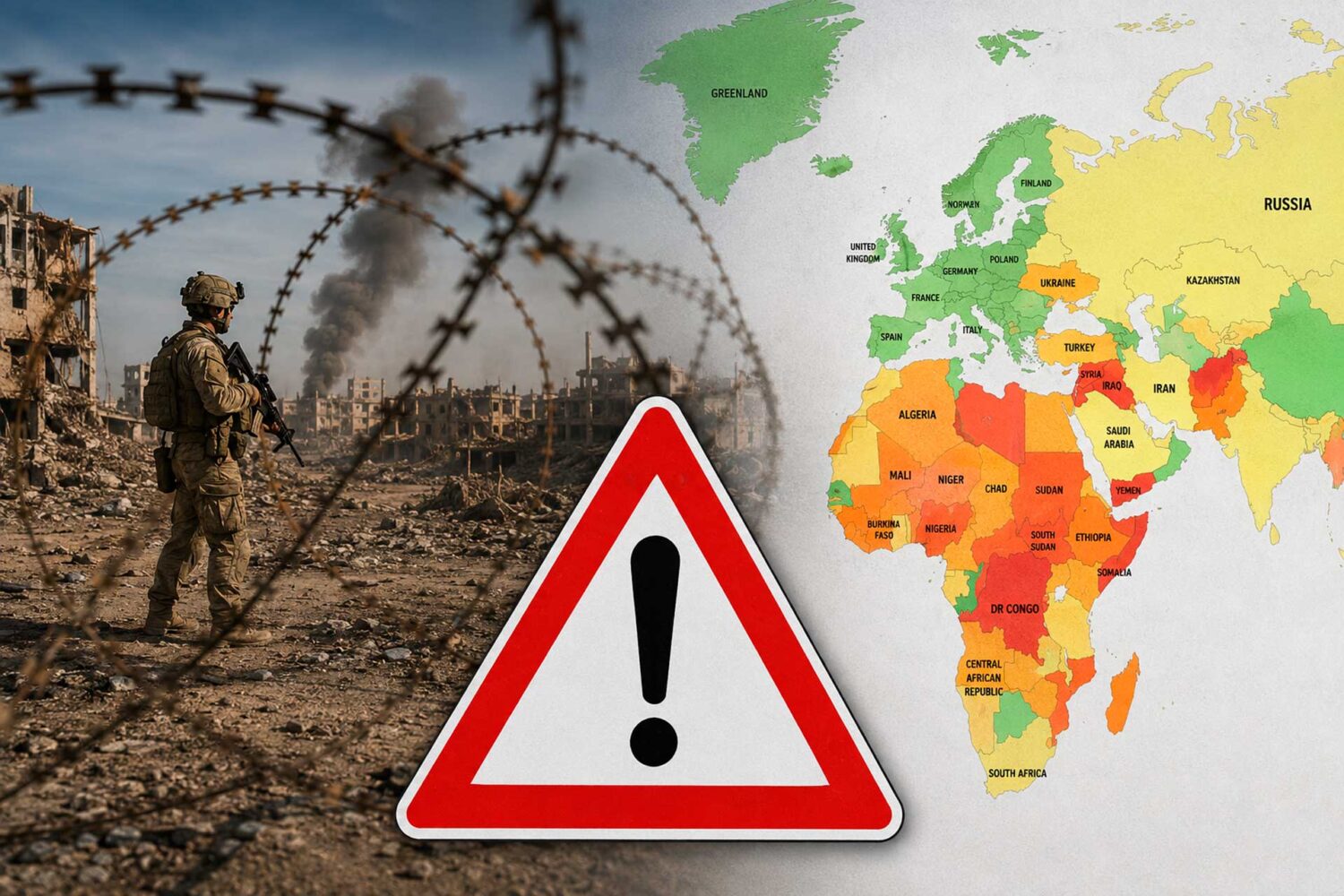
Beyond overall rankings, certain countries stand out in specific categories of risk:
- Crime: Numbeo’s 2026 data list Papua New Guinea, Venezuela, Haiti, Afghanistan, South Africa, Honduras, Trinidad & Tobago, Syria, Jamaica, and Guyana as the highest crime indexes. Afghanistan and Syria overlap with our “dangerous” list. Countries like Mexico and Brazil also have very high violent-crime rates. Among the GPI top-25, high-crime nations include South Africa, Nigeria, Brazil, Ukraine, Sudan, and Afghanistan.
- Tourist Safety: According to multiple travel surveys and advisories, the highest risks to tourists come from regions with active conflicts. For example, Mexico, Colombia and Venezuela see many tourists hurt in crime, while European advisories warn of terrorism in parts of Turkey and the Balkans. None of the “top 10 most dangerous” countries is considered safe for leisure travel – all are either under “Do Not Travel” advisories or active warzones. Even countries like Mexico or The Philippines (high kidnapping/crime) rank high in danger-for-tourists lists but do not appear in GPI top-10, showing that tourism risk can differ from overall peace ratings.
- War and Conflict: The most dangerous warzones currently include Ukraine, Gaza (Palestine), Syria, Yemen, and Sudan, which align with our top-10. (ACLED data show well over 10,000 battle deaths/year in just Ukraine and Sudan alone.) Other conflict spots not in the top-10 but regionally very dangerous are Ethiopia’s Tigray, Myanmar, and Libya.
- Terrorism: Global Terrorism Index reports (2023–2025) consistently rank Pakistan, Nigeria, Afghanistan, Somalia, and Yemen as highest-impact terrorism hotspots. Among our top-10, Afghanistan, Yemen, and Nigeria (rank 16) have very high GTI scores. Notably, some traditionally violent countries (Somalia, Libya) are high on the terror index even if not in our immediate top-10 table.
- Kidnapping: According to reported data, Pakistan has the highest total kidnappings worldwide (30,000+ annually), far above any Middle Eastern or African country on our list. (Brazil and Mexico also report thousands of kidnappings each year.) On a per-capita basis, small unstable states (Haiti, Venezuela) have high rates. This shows that even if a country’s overall “danger” rank is lower, certain crimes like kidnapping can be extremely prevalent.
- Women’s Safety: Research from the Thomson Reuters Foundation and gender-gap metrics indicate that Afghanistan, DRC, Somalia, and Yemen are among the worst for women’s security (due to violence, kidnapping, or lack of rights). Our list includes many of these. In war-torn states, gender-based violence is tragically common.
- Solo Travelers: Generally, solo travelers (especially those without local support) face the same combined dangers listed above. Some specific warnings: northern Mexico is extremely dangerous for foreigners (due to cartels), and West Bank areas can spike in violence. But there’s no rival for dangers like active battlefields (Ukraine, Sudan, Gaza) or lawless failed states (Somalia).
- Journalists: By the World Press Freedom Index, the most repressive (and thus dangerous for journalists) include North Korea, Eritrea, Iran, Syria, and China. Some overlap exists: Syria and Iran appear as both journalist and overall danger zones. Reporters in warzones (Ukraine, Yemen, Sudan, Afghanistan) face extreme risk – according to the Committee to Protect Journalists, Afghanistan and Syria top global lists for journalist fatalities in recent years.
Each category highlights nuances. For example, India and Brazil rank relatively better in GPI (due to no active war) yet are high in crime and corruption, making them dangerous in other ways. Conversely, Mali or Niger face extreme terrorism risk with fewer foreign visitors to notice. Our integrated “danger” view weights all factors rather than one.
Safer-Country Alternatives
For travelers or expatriates deterred by these dangers, the table below suggests nearby safer countries (with generally stable conditions). These alternatives have similar cultures or geography but much lower risk levels:
| Dangerous Country (Rank) | Safer Alternative |
|---|---|
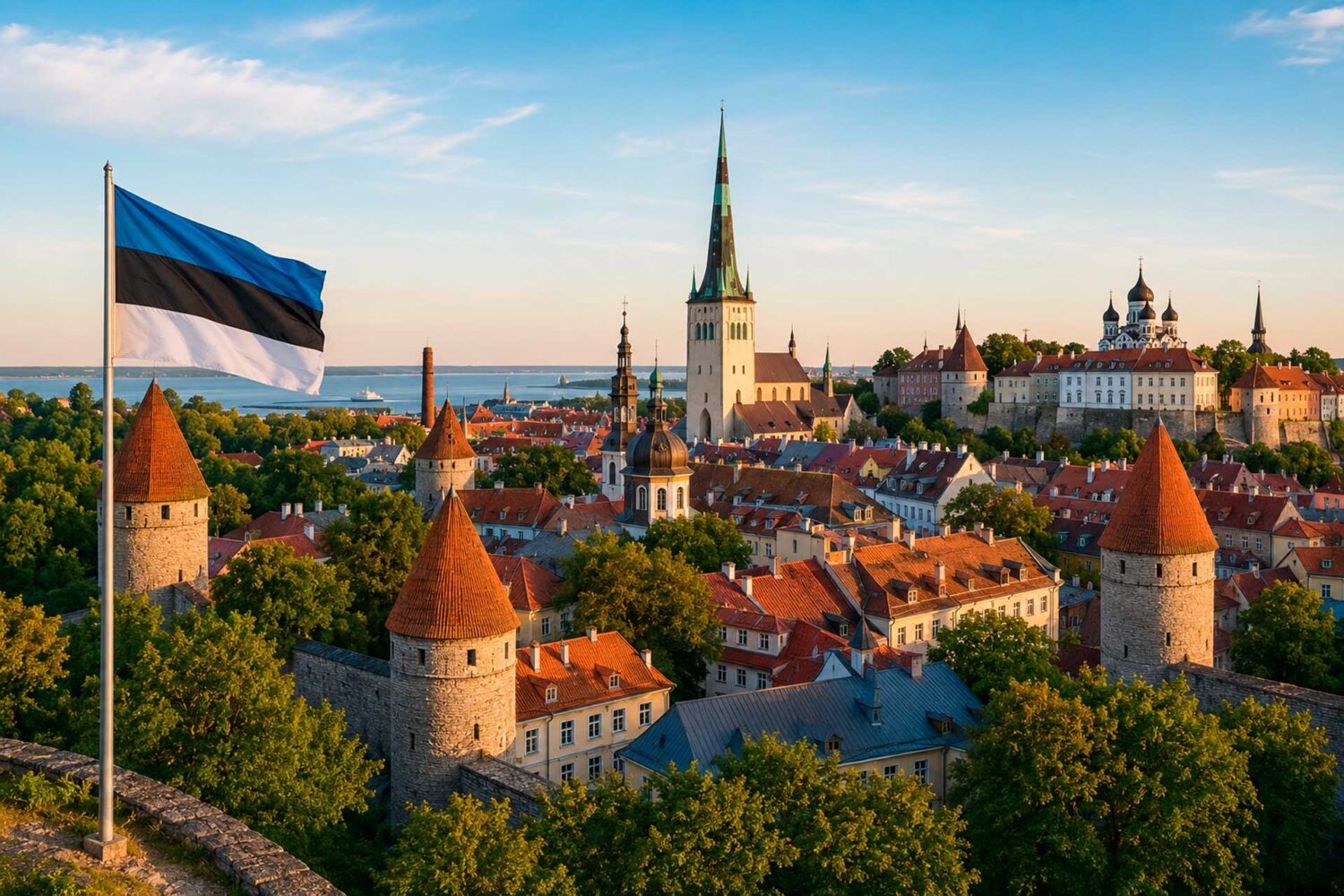
| Russia (1) | Norway, Finland, or Estonia (Europe) – peaceful democracies adjacent to Russia. |
| Ukraine (2) | Poland or Slovakia (EU neighbors with Western safety). |
| Sudan (3) | Egypt (Northern Africa travel), or Ethiopia (both are more stable). |
| DR Congo (4) | Uganda or Rwanda (East Africa; stable governments, good parks). |
| Yemen (5) | Oman (neighbor to the east), UAE or Qatar (Gulf states, stable). |
| Afghanistan (6) | Uzbekistan or Kyrgyzstan (Central Asia with historical Silk Road sites). |
| Syria (7) | Jordan (stable, ancient sites) or Lebanon (pre-2020, though note recent unrest). |
| South Sudan (8) | Uganda or Kenya (East African safaris and cultures). |
| Israel (9) | Jordan or Cyprus (visit Middle Eastern history safely) – or Egypt (Sinai). |
| Mali (10) | Morocco or Ghana (Safer West African nations with rich culture). |
| Myanmar (11) | Thailand or Vietnam (Southeast Asia, historically tourism-friendly). |
| Burkina Faso (12) | Senegal or Morocco (West African alternatives). |
| Central African Rep. (14) | Gabon or Rwanda (Central Africa, much safer). |
| Nigeria (16) | Ghana or Botswana (Sub-Saharan cultures, safer). |
| Iraq (17) | Turkey (for Mesopotamian history) or Jordan. |
| Turkey (18) | Greece or Cyprus (Eastern Mediterranean, stable EU states). |
| Palestine – Gaza (19) | Israel’s South (e.g. Eilat, but only if war halts) or Jordan. |
| Haiti (23) | Dominican Republic (same island, but safer), or Jamaica/Panama (Caribbean). |
| Colombia (24) | Chile or Argentina (South America’s safest countries). |
| Venezuela (25) | Peru or Brazil (southeast SA, more stable) or Costa Rica (Central America). |
Each suggestion offers cultural or geographic similarity without the conflict/instability. For example, travelers from Yemen might instead experience Arabian culture in Oman; those avoiding Mali’s desert might go to Morocco’s Sahara. Always verify current local conditions, but these alternatives rank well in global safety indices (GPI, Global Terrorism Index, etc.) and have decent infrastructure for tourism.
Not sure where it’s safest to move in 2026? Safety rankings are only one part of the picture. We analyze immigration laws, tax implications, healthcare systems, family relocation options, and long-term residence prospects to help you make an informed decision. Leave a request for a consultation, and our immigration lawyers will prepare a personalized relocation strategy based on your goals and circumstances.
Schedule a free consultation and get detailed information from Unioncitizenship lawyers. Start the process today!

Travel Safety Tips
Staying safe in or near dangerous countries requires vigilance and planning:
- Monitor Official Advisories: Before any trip, check travel advisories from your government (US State Dept, UK FCDO, etc.). Note country- and region-specific warnings. Register with embassy notifications if possible.
- Avoid Flashpoints: Keep clear of known conflict zones and demonstrations. For example, Ukraine’s eastern front, Gaza, or neighborhoods near military bases should be off-limits. Stick to areas designated as “safe” or government-controlled.
- Blend In: Dress modestly and avoid displaying valuables. Maintain a low profile, especially where foreigners or certain groups might be targets. Move discreetly, avoid traveling at night or on empty roads (checkpoint and bandit risk).
- Travel Insurance: Ensure you have comprehensive coverage that includes evacuation, kidnapping, and medical repatriation. Many government advisories explicitly recommend this (e.g. Afghanistan, Yemen).
- Emergency Preparedness: Have contingency plans. Keep copies of passports/documents safe, share itineraries with friends/family, and know how to contact your embassy in an emergency. In some countries (e.g. Syria, Sudan) governments may not provide assistance, so know local laws and safe exits.
- Cultural Awareness: Research the local culture deeply. In volatile regions, misunderstandings can escalate. Respect local customs and avoid political discussions. Be especially cautious about social media posts, as even private messages can raise suspicion in police states (e.g. Russia).
- Stay Informed: Security situations can change rapidly. Follow local news and international reports. For example, the U.S. Embassy often issues country-specific alerts. In Sudan, fighting moved unexpectedly into Khartoum in April 2023, catching some residents off-guard.
- Medical Precautions: Get all recommended vaccinations (Yellow Fever, cholera, etc.) and carry necessary medications. In places like Yemen or DRC, disease risk is high. Drink bottled water only and have sanitation supplies.
- Local Contacts: Establish contact with a reputable local fixer, security consultant, or humanitarian organization if travel is absolutely necessary. Avoid going solo into high-risk areas.
If you find yourself in a dangerous situation, prioritize escape over possessions. Follow local authority instructions, but remember that in warzones, local forces might be hostile. Always consider leaving immediately if stranded in a deteriorating area – as many advisories put it for Afghanistan and Sudan.
Travelers and policymakers must remain vigilant. The world’s most dangerous countries are those mired in war, terror and instability. This report’s data-driven approach – combining GPI scores, terror metrics, health alerts and advisories – highlights the grim reality in places like Russia, Ukraine, Sudan, Yemen, Afghanistan and others. We recommend that individuals only visit such countries if absolutely necessary, and only with thorough preparation (insurance, evacuation plans, local contacts).
For regular travel, consider the safer alternatives listed above. If you or a loved one are planning international travel or relocation, consider contacting an immigration or travel safety expert. Subscribe to official travel alerts and stay updated on global events. Your safety depends on accurate information and careful planning. Always consult up-to-date government travel advisories and local news before any trip. Sign up for travel alerts (e.g. U.S. Smart Traveler Enrollment Program or equivalent) to receive immediate warnings on crises. Stay informed. Stay prepared. Stay safe.
Looking for a Safer Country to Live? Gain Greater Freedom Through a Second Citizenship! A second citizenship or residence permit can provide greater mobility, access to stable countries, and more opportunities for you and your family. If you’re considering relocating from a high-risk region, we’ll help you compare the available legal pathways and choose the solution that best meets your objectives. 👉 Leave a request for a consultation and let our experts develop a personalized relocation plan.


Find out details about obtaining an EU passport at a free consultation
Fill out a simple form and an immigration lawyer will contact you shortly.