


Most Beautiful Countries in the World: 2026 Rankings
- How the shortlist was built
- Top 10 most beautiful countries in the world
- Where beauty meets practicality
- Conclusion
There is no single official global ranking of the “most beautiful countries in the world,” because beauty is inherently subjective. This report therefore uses a research-based editorial method: it combines recent travel-guide consensus, UNESCO-recognized natural and cultural landmarks, and current tourism-development signals to identify the ten countries that most consistently stand out for both scenery and sense of place.
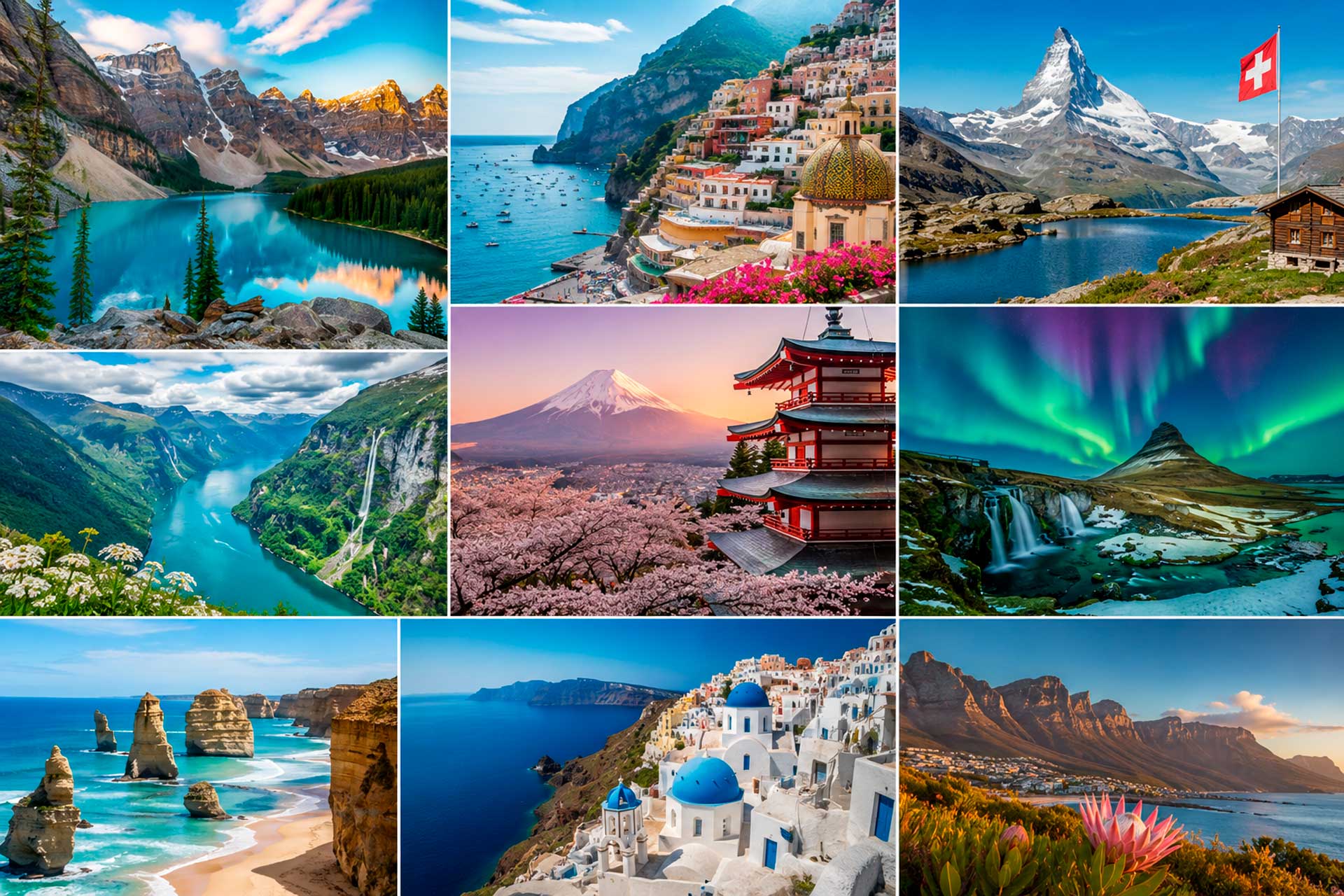
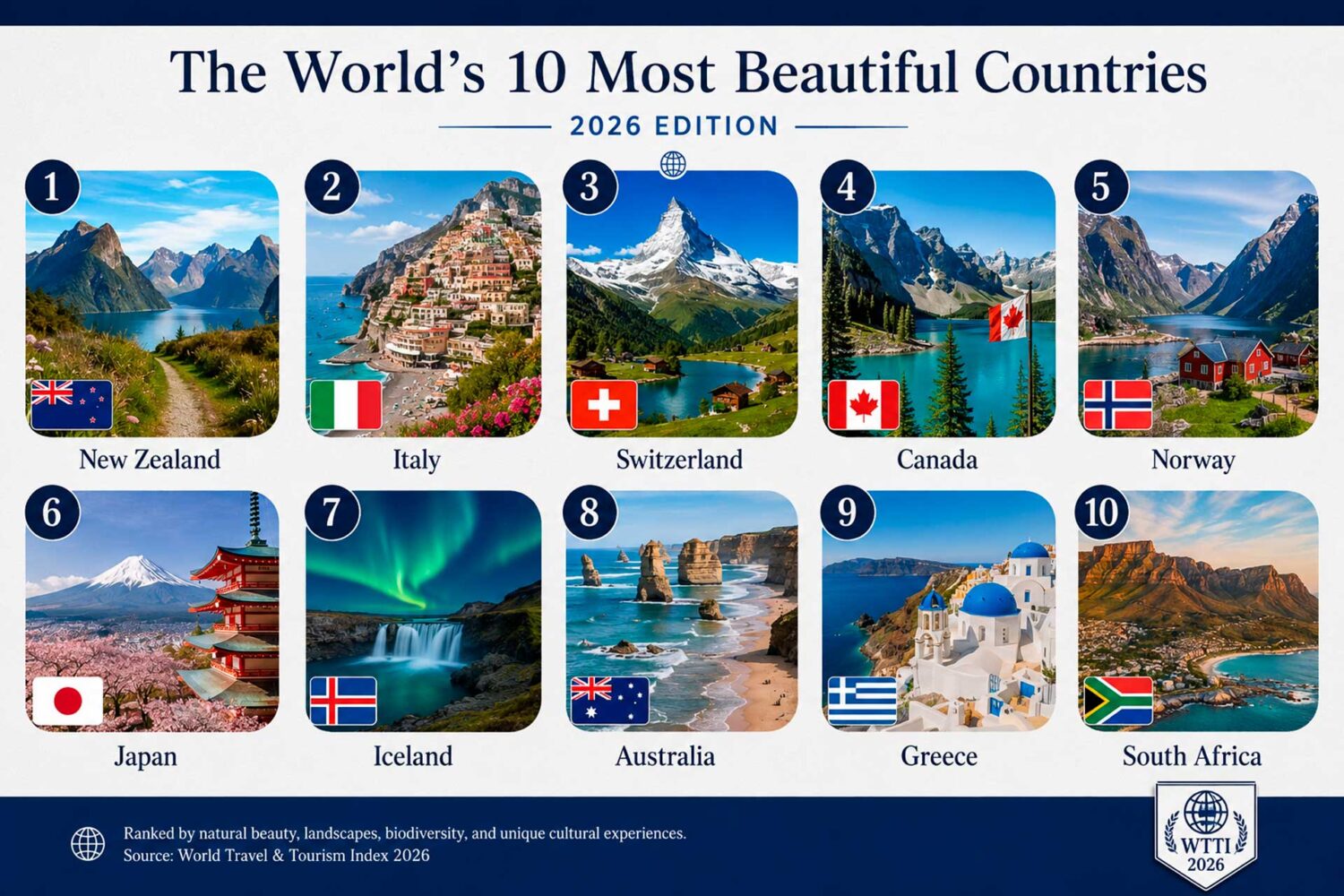
The final top ten in this synthesis are New Zealand, Italy, Switzerland, Canada, Norway, Japan, Iceland, Australia, Greece, and South Africa. Together they offer the widest and strongest combination of fjords, glaciers, reefs, volcanoes, islands, dramatic coasts, heritage cities, sacred landscapes, and living cultural traditions.
From an immigration perspective, the most practical all-round relocation options in this scenic group are generally Canada, Australia, and New Zealand for skilled migrants, with Japan attractive for advanced professionals and Italy/Greece more compelling for lifestyle or investor-led residence. For broad visa freedom, the key milestone is normally citizenship rather than temporary residence, with Japanese, Swiss, New Zealand, Australian, and Canadian passports all sitting in the upper tier of the latest Henley ranking, while Italian or Greek citizenship also unlocks EU free movement rights.
How the shortlist was built
This article does not treat tourist arrivals as a beauty contest. Instead, it uses a three-part filter.
- First, it looks for recent travel-editor and reader consensus: Rough Guides’ 2025 reader vote explicitly ranks the world’s most beautiful countries, while Lonely Planet’s Best in Travel 2024 and 2025, National Geographic’s Best of the World and Cool List, and Condé Nast Traveller’s annual “Best Places to Go” all show how leading travel brands currently prioritize scenery, nature, culture, and seasonality when curating destination shortlists.
- Second, the shortlist checks for internationally recognized landmark value through UNESCO. That matters because UNESCO is the strongest global benchmark for places of exceptional cultural or natural significance, from the Dolomites and Canadian Rockies to Mount Fuji, Meteora, the Great Barrier Reef, and the West Norwegian Fjords.
- Third, the report uses current tourism momentum only as a confidence check. The World Economic Forum’s Travel & Tourism Development Index 2024 places Japan 3rd, Australia 5th, Italy 9th, Switzerland 10th, Canada 11th, Greece 21st, New Zealand 25th, and Iceland 32nd, while UN Tourism reports that international tourism recovered strongly in 2024 and continued growing in 2025. In other words, the list below reflects places that are not only beautiful on paper, but also highly validated by current global travel behavior.
Nine of the ten countries below appear directly in Rough Guides’ 2025 beauty vote. Australia is the deliberate substitution: it is added because it ranks 5th globally on the WEF tourism-development index and combines two of the world’s most iconic UNESCO natural landscapes, the Great Barrier Reef and Uluru-Kata Tjuta.
Top country snapshot
| Country | Top attractions | Best time to visit | Main landscape type |
|---|---|---|---|
| New Zealand | Fiordland, Tongariro, Rotorua, alpine lakes | December to March, or March to May | Fjords, volcanoes, alpine coasts |
| Italy | Dolomites, Amalfi Coast, Tuscany, Rome/Florence/Venice | April to June, September to October | Alps, coasts, vineyard hills, heritage cities |
| Switzerland | Jungfrau region, Zermatt, Alpine lakes, scenic railways | June to September, or December to March for snow | Alpine glaciers, lakes, mountain villages |
| Canada | Canadian Rockies, northern lights, coast-to-coast wilderness, Montréal/Québec | June to September, early October | Mountains, forests, lakes, Arctic and ocean coast |
| Norway | Lofoten, Geirangerfjord, Nærøyfjord, Flåm, Arctic north | June to August, or February to March for aurora trips | Fjords, Arctic coasts, mountains |
| Japan | Mount Fuji, Kyoto, Hokkaido, historic shrines, Tokyo views | Late March to April, or October to November | Volcanoes, mountains, historic urban landscapes |
| Iceland | Ring Road, black-sand beaches, waterfalls, Vatnajökull, geothermal fields | June to August for road trips; September to March for aurora | Volcanoes, glaciers, lava coasts |
| Australia | Great Barrier Reef, Uluru, Tasmania, coastal cities, outback | May to October for the north/reef; May to September for the Red Centre | Reef, desert, beaches, bush |
| Greece | Santorini, Meteora, Cyclades, Athens, island beaches | Mid-April to June, September to mid-October | Islands, coasts, rocky mainland, heritage sites |
| South Africa | Cape Town, Garden Route, Kruger, Winelands, Drakensberg | May to October for safari; spring/autumn for the Cape | Coast, mountains, savanna, floral landscapes |
Dreaming of more than just a memorable trip? Leave a request for a consultation, and our specialists will help you explore the best countries for relocation, compare residence and citizenship options, and find a destination that offers not only stunning scenery but also the right opportunities for your future.
Schedule a free consultation and get detailed information from Unioncitizenship lawyers. Start the process today!

Top 10 most beautiful countries in the world
New Zealand
New Zealand is the clearest cross-source winner in this synthesis: it topped Rough Guides’ 2025 reader vote, and Tourism New Zealand still defines its appeal through Fiordland’s Milford and Doubtful Sounds, geothermal Rotorua, glacier country, and outdoor culture. UNESCO adds unusual depth via Tongariro National Park, where active volcanoes, dramatic scenery, and Māori spiritual meaning form one of the world’s landmark cultural landscapes. Representative image source page: Fiordland on Tourism New Zealand.
Italy
Italy remains one of the most complete beauty destinations on earth because it pairs first-rank scenery with first-rank civilization: the Dolomites, Amalfi Coast, Italian lakes, vineyards of Tuscany, and art cities such as Rome, Florence, and Venice all belong to the same itinerary. Italia.it frames the country as a mix of sea, mountains, cities, parks, and UNESCO sites, while UNESCO describes the Dolomites as mountain landscapes of exceptional natural beauty. Representative image source page: Dolomiti on Italia.it.
Switzerland
Switzerland is the purest Alpine beauty state in Europe: glacier panoramas, mirror lakes, impeccable mountain villages, and legendary rail journeys all compress into a very small space. Switzerland Tourism places the Jungfrau region and Aletsch Glacier at the center of its imagery, and UNESCO notes that Jungfrau-Aletsch contains Europe’s largest glacier and some of the High Alps’ most important geological features. Representative image source page: The Jungfrau Region on Switzerland Tourism.
Canada
Canada makes the top tier because of scale: the Canadian Rockies, Arctic skies, Pacific rainforests, Atlantic coasts, and vast northern wilderness collectively create one of the largest scenic ranges on the planet. UNESCO describes the Canadian Rocky Mountain Parks as a place of rugged peaks, glaciers, alpine meadows, lakes, waterfalls, and canyons of exceptional natural beauty, while Destination Canada emphasizes the country’s coast-to-coast cultural mosaic and wilderness identity. Representative image source page: Canadian Rockies on Alberta Canada.
Norway
Norway earns its place through some of the most archetypal dramatic scenery in the world: sheer-sided fjords, Arctic islands, glacier-cut valleys, and villages that seem built for postcards. Visit Norway highlights Geirangerfjord, Flåm, Tromsø, and Lofoten, while UNESCO calls the West Norwegian Fjords a classic type locality for fjord landscapes. Representative image source page: Lofoten Islands on Visit Norway.
Japan
Japan stands out because beauty here is both natural and composed: Mount Fuji, cedar forests, temple gardens, Kyoto streetscapes, autumn maples, and hyper-modern city skylines all reinforce one another instead of competing. JNTO continues to present Fuji as a signature national icon, and UNESCO describes it as a sacred place and source of artistic inspiration that has shaped Japanese culture for centuries. Representative image source page: Mt. Fuji Guide on Travel Japan.
Iceland
Iceland looks almost algorithmically designed for visual impact: black-sand beaches, lava fields, blue ice, active geothermal zones, whale-rich coasts, and an all-road-trip national layout. Visit Iceland’s Ring Road guide summarizes the country well, describing an island of glacier-capped volcanoes, waterfalls, and dramatic coasts, while UNESCO identifies Vatnajökull as a globally important “fire and ice” system. Representative image source page: Iceland’s Ring Road on Visit Iceland.
Australia
Australia replaces one Rough Guides entry because few countries can match its sheer range: the Great Barrier Reef, red monolith deserts, eucalyptus bush, surf coasts, tropical north, and temperate islands are all world-class on their own. UNESCO calls the Great Barrier Reef a site of remarkable variety and beauty and describes Uluru-Kata Tjuta as a spectacular geological landscape, while Tourism Australia frames both as national must-sees. Representative image source page: Great Barrier Reef guide on Tourism Australia.
Greece
Greece belongs in any beauty list because it fuses island perfection with classical depth: caldera views in Santorini, cliff monasteries at Meteora, clear Aegean water, archaeological grandeur, and a luminous Mediterranean climate. Visit Greece presents Santorini through its volcanic landscapes and black, red, and white beaches, while UNESCO describes Meteora’s monasteries on “heavenly columns” as one of the world’s great monuments. Representative image source page: Santorini on Visit Greece.
South Africa
South Africa closes the list because it is arguably the world’s best blend of wildlife drama and coastal/mountain elegance: Cape Town, the Garden Route, the Winelands, Kruger, and the Drakensberg deliver striking variety within one country. South African Tourism describes a destination that moves from city life and culture to coastline and safari, and UNESCO notes that the Cape Floral Region is one of the world’s great centres of terrestrial biodiversity. Representative image source page: Discover the Garden Route on South African Tourism.

Where beauty meets practicality
For people who want to live in one of these countries rather than only admire it, the strongest practical migration choices are generally Canada, Australia, and New Zealand. Canada publishes Express Entry as a flagship skilled-worker route to permanent residence, Australia’s skilled migration program explicitly includes pathways from skilled visas to permanent residence, and New Zealand’s Skilled Migrant Category Resident Visa is a direct residence pathway for qualified workers. From a planning perspective, these three remain the clearest beauty-plus-practicality trio in the list.
Japan is a strong option for highly qualified professionals rather than general applicants. Its Ministry of Foreign Affairs continues to maintain a dedicated Highly Skilled Professional category, making it especially relevant for researchers, executives, engineers, and other advanced specialists who want an urban, high-culture, high-infrastructure destination.
Norway and Switzerland are attractive but more selective. Norway’s UDI makes clear that work immigration generally requires a residence permit and usually a job first, while Switzerland’s SEM states that non-EU/EFTA nationals face labor-market access restrictions and priority rules in favor of Swiss and EU/EFTA workers. In practical terms, both are excellent destinations when a strong employer fit already exists, but they are not as open-ended as the main points-based systems in Canada or Australia.
Italy and Greece are especially compelling for lifestyle-led relocation, remote wealth, or investment. Greece’s official Golden Visa materials describe a 5-year renewable residence permit for qualifying investors, while Italy’s investor visa is described officially as a 2-year visa for non-EU citizens investing in strategic Italian assets; Italy’s Interior Ministry also states that foreigners legally resident for at least ten years may apply for citizenship. These are meaningful routes, but they are more investor- and lifestyle-friendly than they are broad skilled-labor migration systems.
For global travel freedom, residence and citizenship should be treated differently. Residence rights help a person stay, work, and in some cases move more easily within a region, but broad passport power normally comes only after citizenship. In Henley’s January 2026 update, Japan is joint 2nd, Switzerland joint 3rd, New Zealand 6th, Australia 7th, and Canada 8th; separately, EU citizenship gives the right to move and reside freely within the EU, which is especially relevant for Italy and Greece.
The exact route varies by country, but the broad planning logic is usually the same:
- Choose a country and route.
- Work Study Investor or Family visa.
- Temporary residence.
- Permanent residence or equivalent.
- Citizenship eligibility.
- Stronger passport and wider visa-free travel.
In practice, Canada, Australia, and New Zealand tend to fit this sequence most clearly for skilled migrants; Japan often fits it for high-skill talent; Norway and Switzerland fit it best when employer sponsorship is already in place; and Greece or Italy fit it best for investors, lifestyle movers, or long-term settlement planners.
Ready to turn your relocation plans into reality? Our immigration experts can help you identify the most suitable residency, visa, or citizenship pathway based on your profile. Book a free consultation today and take the first step toward your new life abroad.
Schedule a free consultation and get detailed information from Unioncitizenship lawyers. Start the process today!

Conclusion
What is the most beautiful country in the world? The answer is inevitably subjective, but the most beautiful countries in the world are not simply the ones with the biggest mountains or the bluest coasts. The strongest contenders are the countries where landscape, culture, history, and travel experience reinforce one another. On that basis, New Zealand, Italy, Switzerland, Canada, Norway, Japan, Iceland, Australia, Greece, and South Africa form the most convincing current top ten. Each offers a unique combination of natural wonders, cultural heritage, and unforgettable experiences that consistently place them among travelers’ favorite destinations.
For readers thinking beyond tourism, the practical takeaway is equally clear: Canada, Australia, and New Zealand are the best scenic countries in this group to target for mainstream skilled migration; Japan is a strong premium option for advanced professionals; Greece and Italy are attractive for lifestyle and investment planning; and genuine long-term visa freedom usually follows citizenship, not temporary residence.
A final limitation remains important: no official body publishes an objective “beauty league table,” so any top ten is necessarily an informed synthesis rather than a scientific measurement. That said, the countries above are the ones most consistently validated by current travel editors, UNESCO heritage recognition, and live tourism relevance.
If you are not only looking for beautiful places to visit but also considering relocating abroad, choosing the right country involves much more than scenery alone. Leave a request for a consultation, and our specialists will help you compare immigration opportunities, residency options, quality of life, and long-term prospects to find the destination that best matches your goals.


Find out details about obtaining an EU passport at a free consultation
Fill out a simple form and an immigration lawyer will contact you shortly.