


What Are the Safest Countries in the World in 2026?
- How Safety Is Measured in 2026
- Safest Country vs Safest to Visit: Key Difference
- Top 10 Safest Countries in the World (Overall Ranking – 2026)
- Safest Countries to Visit in 2026 (Travel Safety Ranking)
- Safest Countries by Region (2026)
- Safest Countries for Different Travelers (2026)
- Safest Countries to Move to in 2026
- What Changed from 2025 to 2026?
“Safe country” no longer means just low crime. In 2026, rankings increasingly account for political stability, healthcare resilience, cyber safety, climate risk, and how secure travelers actually feel on the ground. Below are two quick lists of the top five safest countries overall and for travelers, followed by a methodology overview:
- Top 5 Safest Countries (Overall – 2026): 1. Iceland – Continues its long reign as the world’s most peaceful and safe nation; 2. Ireland; 3. New Zealand; 4. Austria; 5. Switzerland. (Source: Global Peace Index).
- Top 5 Safest Countries for Travelers (2026): 1. Netherlands – Jumped from 14th to 1st in one year; 2. Australia; 3. Austria; 4. Iceland; 5. Canada. (Source: BHTP travel safety report).
“Safest countries” are determined using data-driven indices. The Global Peace Index (GPI) ranks 163 countries on peace and security (lower scores = safer). For travel, BHTP’s Safest Destinations survey and HelloSafe’s Safety Index evaluate nations on crime rates, health security, disaster risk and traveler perceptions. These sources ensure a comprehensive view of safety from both resident and tourist perspectives.
How Safety Is Measured in 2026
Measuring how “safe” a country is requires looking at multiple indexes, each with its own focus:
Global Peace Index (GPI)
The Global Peace Index is a widely cited metric for overall national safety and peace. Published by the Institute for Economics and Peace, the GPI covers 163 countries and uses 23 indicators across three domains: Societal Safety & Security, Ongoing Conflict, and Militarization. These include factors like violent crime rates, homicide levels, political instability, terrorism impact, and military expenditure.
Countries are scored from roughly 1.1 (very peaceful) to 5+ (very dangerous) – lower GPI scores indicate a safer, more peaceful country. For example, Iceland, with virtually no internal conflict or crime, scores around 1.1, making it the top-ranked peaceful country for over a decade. GPI is updated annually, allowing year-to-year tracking of which countries are becoming more or less safe.
BHTP Travel Safety Survey (Safest Destinations)
Berkshire Hathaway Travel Protection (BHTP) produces an annual “Safest Destinations” ranking focused on traveler safety. This index is part of BHTP’s State of Travel Insurance (SOTI) report and surveys thousands of travelers (primarily U.S.-based) about safety in countries they have visited. BHTP combines these traveler perception scores with hard data from other sources – such as government travel advisories (U.S. State Dept.), global terrorism indices, weather disaster frequency, health risks, and even safety for underrepresented groups (e.g. women, LGBTQ+ travelers).
The result is a weighted safety score for each country, which BHTP uses to rank the world’s safest countries to visit. In 2026, this methodology highlighted some shifts – the Netherlands climbed to #1 as perceived by travelers, reflecting its low crime, strong infrastructure, and inclusive safety measures. BHTP’s approach emphasizes where travelers feel safe and accounts for threats like terrorism or natural disasters that might not always show up in general peace indexes.
“World Safety Index” (HelloSafe’s Composite Index)
Financial comparison platform HelloSafe has developed a World Safety Index for travel, offering a multidimensional look at country safety (0–100 scale). This index blends 5 pillars of safety with weighted importance:
- Public Safety & Crime (35%) – rates violent crime, theft and law enforcement effectiveness.
- Political & Social Stability (25%) – considers government stability, conflict, and social unrest.
- Health Security (15%) – assesses healthcare quality, pandemic preparedness, and disease risk.
- Cybersecurity (15%) – evaluates digital infrastructure safety and cybercrime prevalence.
- Environmental Risk (10%) – gauges natural disaster risk and climate resilience.
HelloSafe pulls data from reputable sources (UN crime data, World Bank, WHO, ITU, etc.) and perception surveys (Numbeo crime index, OECD trust indices) to calculate a composite “safety score”. Higher scores mean safer overall conditions for residents and travelers. For instance, in the 2026 HelloSafe rankings, Iceland scored 92.4/100 – the highest globally, due to its negligible crime, strong healthcare and low environmental risk.
This index broadens the definition of safety beyond crime or conflict alone; it captures how prepared a country is to keep people safe in modern contexts (health crises, cyber threats, climate events). It’s a useful complement to GPI and travel surveys, highlighting that in 2026, safety is holistic – countries need to excel in public security, stability, health, and even digital security to be truly “safe.”
If you’re considering moving to one of the world’s safest countries, it’s important to understand the available immigration options and requirements. Leave a request for a consultation to receive personalized guidance and plan your relocation with confidence.
Schedule a free consultation and get detailed information from Unioncitizenship lawyers. Start the process today!

Safest Country vs Safest to Visit: Key Difference
| Aspect | Safest in the World | Safest to Visit |
|---|---|---|
| Main focus | Peace, political stability, absence of conflict | Risk faced by tourists |
| Primary purpose | Measures how peaceful a country is overall | Measures how safe a country is for travelers |
| Key index used | Global Peace Index (GPI) | BHTP Travel Safety Index, World Safety Index |
| Crime measurement | Focus on national violence and conflict | Focus on crime affecting visitors |
| Includes healthcare quality | Limited | Yes |
| Includes natural disaster risk | No | Yes |
| Includes terrorism risk | Partially | Yes |
| Includes cyber & digital safety | No | Often included |
| Best suited for | Long-term living, relocation, macro analysis | Short-term travel, tourism decisions |
A country can rank among the safest in the world while not being the safest to visit, and vice versa. Understanding the difference helps travelers and long-term planners choose the right destination based on their needs.
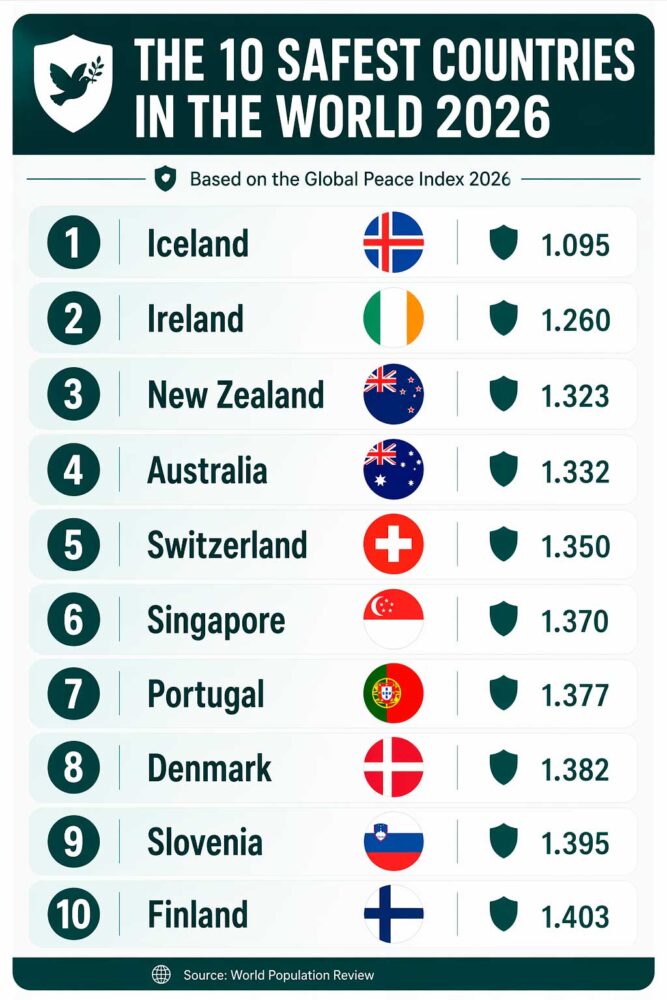
Top 10 Safest Countries in the World (Overall Ranking – 2026)
Based on the latest global peace and security data, here are the top 10 safest (most peaceful) countries in the world going into 2026. These nations score highest on stability, low violence, and societal safety. (Source: GPI 2025 rankings, where a lower score indicates higher safety)
1. Iceland
Iceland is the safest country in the world for the 17th consecutive year. This Nordic nation maintains extremely low crime rates, no military, and a high level of social cohesion. Violent crime is virtually non-existent, and police officers do not carry firearms. Iceland also has no ongoing domestic or international conflicts and excels in political stability and civil liberties. Its consistent top GPI rank (score ~1.1) reflects an outstanding safety record across all indicators – from personal safety to minimal terrorism impact. In short, Iceland’s combination of strong institutions, community trust, and isolation from global conflicts keeps it #1 in safety year after year.
2. Ireland
Ireland ranks as the second-safest country globally. A long-standing policy of military neutrality and a stable democracy contribute to its high peace score. Outside of a few urban petty crimes, Ireland sees very little violence or unrest. Terrorism and civil conflict are minimal (especially since the Good Friday Agreement brought lasting peace to Northern Ireland decades ago). Ireland also scores well on societal safety – surveys indicate people generally feel secure throughout the country. Notably, ~78% of Irish women report feeling safe walking alone at night, highlighting the secure environment. With its effective governance, low crime, and strong community ties, Ireland remains firmly near the top of global safety rankings.
3. New Zealand
New Zealand is the safest country in the Asia-Pacific region and third overall. It enjoys very low violent crime and is geographically removed from most conflict flashpoints. New Zealand’s society emphasizes tolerance and the rule of law; police typically do not carry guns, and incidents of violent confrontation are rare. The country improved its peacefulness in recent years, rising in rank thanks to reductions in internal conflict and weapon imports. New Zealand also famously lacks dangerous wildlife that might concern travelers. Its government and communities invest heavily in safety and emergency preparedness (e.g. strict gun laws enacted after 2019). All these factors combined make New Zealand one of the world’s most tranquil and safe places, whether you’re a resident or visitor.
4. Austria
Austria continues to be a top-tier safe country. Ranked 4th globally, Austria is characterized by political neutrality and social stability. It has very low violent crime rates and has largely avoided the terrorism or unrest seen elsewhere. While Austria saw some minor demonstrations in recent years, they are typically peaceful and localized. The country’s justice system is effective, and citizens trust the police and institutions. Austria also benefits from its location in the heart of Europe – it maintains friendly relations with neighbors and has no external conflicts. In GPI’s domains, Austria scores especially well in Societal Safety & Security, reflecting secure living conditions. Overall, its mix of economic prosperity, low crime, and robust social services makes Austria one of the safest nations on Earth in 2026.
5. Switzerland
Switzerland is synonymous with stability and safety, ranking 5th worldwide. Known for its longstanding neutrality, Switzerland avoids international conflicts and hosts many peace negotiations. Domestically, it boasts very low crime and high personal safety – violent incidents are rare. Switzerland’s wealth and effective governance contribute to social harmony; there are strong community-police relations and a high quality of life. The country did experience a slight militarization uptick (due to defense spending) but remains extremely peaceful. Notably, Switzerland’s political system of direct democracy and federalism encourages consensus and civic participation, reducing civil unrest. With secure cities (Geneva, Zürich) and excellent emergency services, Switzerland continues to be one of the world’s safest, most prepared countries.
6. Singapore
Singapore is Asia’s safest country and ranks 6th globally on the GPI. This city-state is famous for its exceptionally low crime rate – thanks in part to strict laws and rigorous law enforcement. Violent crime and drug-related offenses are minimal, making everyday life secure. Singapore also enjoys complete domestic tranquility (no insurgencies or terror incidents) and strong economic stability. On the GPI, it shines in the Safety and Security domain, reflecting how safe citizens feel. In fact, surveys show Singapore residents have among the highest sense of personal security in the world. The trade-off is heavy penalties for crime and a highly monitored society, but this results in clean, orderly streets. For 2026, Singapore remains a model of urban safety and efficient governance, keeping it firmly in the top ten safest nations.
7. Portugal
Portugal has steadily climbed in safety rankings, now at 7th globally. It transformed from 18th in 2014 to the top 10 by focusing on crime reduction and economic stability. Today, Portugal is one of Europe’s safest countries: violent crime is low, and even petty crime is limited to tourist hotspots. Notably, increased police presence in cities like Lisbon and Porto over the past decade led to significant drops in crime rates. Portugal also enjoys political stability and has no external conflicts. Its society values tolerance (Portugal consistently ranks among the most LGBTQ-friendly and welcoming countries), contributing to internal peace. For travelers and locals alike, Portugal offers a secure environment – reflected by ~72% of women feeling safe walking alone at night. Safe, sunny, and socially stable, Portugal is a success story in improving national safety.
8. Denmark
Denmark is 8th on the global safety list, exemplifying the security of the Nordic region. Danes experience one of the highest levels of personal safety – surveys show people feel safe at any time of day, a rarity in most countries. Crime rates are very low, and there’s a strong social trust factor: corruption is rare and community welfare is a priority. Denmark’s government provides extensive social services (free education, healthcare), which fosters social cohesion and reduces desperation-driven crime. While Denmark did slightly increase defense spending (due to regional tensions), it remains peaceful internally. The country has no significant conflict involvement and maintains stable relations internationally. Overall, Denmark’s blend of social equality, trust in institutions, and proactive policing keeps it among the world’s safest places.
9. Slovenia
Slovenia is a smaller European nation that consistently punches above its weight in safety, ranking 9th globally. Since gaining independence in the 1990s, Slovenia has built a stable democracy with low crime and high quality of life. It scores excellently on travel security, medical risk, and road safety metrics. Violent incidents are very uncommon, and Slovenia has no ongoing conflicts or serious internal strife. As part of the EU and NATO, it enjoys a secure geopolitical position. The government invests in public safety and healthcare, contributing to societal security. Tourists often remark on how safe Slovenian cities feel. By focusing on development and good governance, Slovenia has become one of the safest countries in both Europe and the world, demonstrating that even a nation of 2 million can achieve top-tier safety.
10. Finland
Finland rejoins the top 10 safest countries in 2025/2026, reflecting improvements in its security environment. Approximately 82% of Finnish women feel safe walking alone at night – a testament to Finland’s secure streets. This Nordic nation has very low crime and strong social stability supported by a high-trust society. Finland did face growing security concerns in recent years due to its proximity to Russia, but it has responded with effective deterrence and maintained domestic peace. In the latest index, reductions in perceptions of criminality and political terror helped Finland’s score. The country also excels in education and social welfare, which correlates with low crime in the long run. With its emphasis on good governance, equality, and community well-being, Finland ensures a safe environment for residents and visitors, rounding out the world’s top ten safest.
It’s worth noting that other countries like Japan, Canada, and Czech Republic also rank very high on safety, though just outside this top 10. For example, Japan consistently scores among the safest on many indices, especially in terms of low violent crime.
Safest Countries to Visit in 2026 (Travel Safety Ranking)
When it comes to traveling, safety can look a little different than overall national peace. Some countries that are peaceful overall might still pose challenges for tourists (due to petty theft, health issues, etc.), whereas others actively cater to traveler safety. Travel safety rankings for 2026 highlight countries that offer tourists peace of mind through low crime, good infrastructure, and reliable healthcare.
What Makes a Country Safe for Travelers?
Key factors include:
- Low Tourist-Targeted Crime: Destinations with minimal rates of pickpocketing, scams, or assault against visitors rank high. For instance, countries like Japan and Singapore have a reputation for being impeccably safe for tourists, where even in big cities travelers can wander freely without fear.
- Health and Sanitation: Travelers prioritize places with clean water, good sanitation, and strong healthcare systems in case of illness. During 2025–26, destinations with robust health security (e.g. widespread hospitals, high COVID-19 vaccination rates) are seen as safer choices.
- Political Stability and Infrastructure: A stable government and lack of civil unrest are crucial. Good transportation infrastructure (safe roads, reliable public transit) and emergency services also boost a country’s travel safety profile. For example, Australia and Canada rank among the safest for visitors due to their political stability and well-developed infrastructure.
- Disaster and Climate Resilience: Vacationers consider natural disaster risks (hurricanes, earthquakes) when assessing safety. New Zealand and Austria, for example, invest heavily in disaster preparedness which reassures travelers. Conversely, a country prone to sudden natural crises might rank lower for travel safety despite peace.
According to a major travel insurance survey, the safest countries to visit in 2026 include the Netherlands, Australia, Austria, Iceland, and Canada. The Netherlands’ jump to the top spot was driven by travelers reporting feeling very safe there, thanks to its low crime and inclusive atmosphere. Similarly, Australia (with its friendly cities and strict gun laws) and Austria (with its orderliness and low crime) give tourists little to worry about. Iceland remains a perennial favorite – virtually no crime and a populace used to assisting visitors. Canada is another: it offers a stable, welcoming environment with excellent healthcare access for travelers.
It’s important to note that travel safety rankings often weigh factors like terrorism threats, health care quality, and even how safe solo or female travelers feel in each destination. For example, BHTP’s index specifically adds points for countries that are known to be safe for women and LGBTQ+ travelers. Meanwhile, HelloSafe’s index shows Nordic and Western European countries dominating the top 10 safest travel destinations – Iceland, Switzerland, Norway, Finland, Denmark all scored above 89/100 on its Safety Index. These places combine near-zero violent crime, high trust in police, clean environments, and strong cyber protections – all contributing to a worry-free trip.
In summary, the safest countries to travel to in 2026 tend to be highly developed, stable democracies with low crime and good infrastructure. Travelers should still exercise normal caution, but in these top-ranked destinations, serious dangers are exceedingly rare.
Safest Countries by Region (2026)
Safety isn’t uniform across the globe – some regions are much safer than others. Below we break down the safest countries on each continent as of 2026, highlighting regional standouts:
- Europe: Europe remains the world’s safest region overall. In fact, 7 of the top 10 safest countries are in Europe, especially in the north and west. The Nordic countries (Iceland, Norway, Denmark, Finland) plus alpine states like Switzerland and Austria consistently lead in low crime and high stability. Europe’s homicide rate is incredibly low (around 0.8 per 100,000 in Nordic nations). Iceland (Europe’s and the world’s #1) and Ireland are prime examples of Europe’s safety success. Even amid some increased militarization due to geopolitics, everyday life in Europe is very secure for most populations.
- Asia: Asia is a mixed region, but East Asia and parts of Southeast Asia are very safe. Singapore is Asia’s safest country (ranked top 6 globally), known for its ultra-low crime. Japan also consistently ranks in the top tier for safety, with minimal violence and strict gun control. Other safe Asian destinations include Taiwan and South Korea, which have high personal safety and advanced emergency systems. It’s worth noting Asia also contains conflict zones (Afghanistan, parts of the Middle East) which rank among the least peaceful. But overall, Asia-Pacific is the second-safest region in the world after Europe, thanks to its low average homicide rates and stable countries.
- North America: In North America, Canada is by far the safest country. Canada typically ranks in the top 15 globally on peace indexes, reflecting its low violent crime and stable society. The United States, by contrast, ranks much lower (outside the top 120) due to higher homicide and violence rates. Within the region, small island nations in the Caribbean vary – some (like Barbados or St. Lucia) are quite safe, while others have more crime. Overall, Canada sets the safety standard for the Americas, with a peaceful environment and strong social stability.
- South America: South America’s safest country is Uruguay or Chile, which consistently rank highest on the GPI in that continent. Notably, South America saw safety improvements recently – 8 of 11 countries became more peaceful in 2025. Uruguay has low violent crime and a stable democracy, making it a safe haven in a region that struggles with crime. Chile also has relatively strong institutions and police. However, parts of South America (Venezuela, Colombia) remain less safe due to crime or unrest. The regional trend is positive, with countries like Peru and Argentina seeing notable safety gains in the past year.
- Africa: Africa’s safety levels range widely. The safest country in Africa is Mauritius, a small island nation ranked 23rd globally in peacefulness. Mauritius enjoys a low crime rate and political stability, making it a standout in Africa. Other relatively safe African countries include Botswana and Ghana, which have maintained order and lower violence. Many African countries face challenges like terrorism or high crime, keeping their global rankings lower. Yet, several have improved – e.g., Sierra Leone and Ghana have been noted for safety gains and are now safer than even some countries in other regions. Travelers to Africa often stick to the safer countries (Mauritius, Botswana, Namibia, etc.) for peace of mind.
- Middle East: The Middle East is often associated with conflict, but safety levels vary significantly across the region. In early 2026, the Middle East remains a mixed safety picture — some nations (especially Gulf monarchies with strong security infrastructure) retain generally safe societies, but recent Iranian attacks on the UAE and neighboring states have made short-term safety conditions more volatile than in prior years. While Qatar, the UAE and Oman had previously been considered among the safer countries in the Middle East due to low crime and strong internal security, the recent conflict has temporarily raised safety risks, especially in areas close to potential military targets or critical infrastructure. Travel advisories from several Western governments now urge caution or even departure from the region.
- Oceania: In the Australia/Oceania region, New Zealand and Australia are the clear safety leaders. New Zealand is ranked #3 worldwide on the GPI, reflecting its extremely low crime and isolation from conflict. Australia also scores very high on safety, with strict gun laws and safe cities – it frequently appears in lists of safe travel destinations. The Pacific Island nations generally have low violent crime but some (Fiji, Papua New Guinea) experience occasional unrest or have weaker infrastructure. Overall, Oceania is a very safe region, anchored by the exceptional safety records of New Zealand (virtually no internal conflict) and Australia (stable, low crime, high standard of living).
Each continent has its safer havens – and as a rule, countries with stable governments, effective law enforcement, and social trust tend to be the safest in any given region.

Safest Countries for Different Travelers (2026)
“Safety” can be personal – what feels safe for one traveler might differ for another. Here we consider which countries are safest for specific types of travelers in 2026, including solo adventurers, women, families, and LGBTQ+ travelers. These recommendations factor in not just crime rates, but also cultural attitudes, legal protections, and comfort levels for each group.
Solo Travelers
For those exploring alone, the best countries offer a mix of low crime, easy navigation, and friendly locals. Japan often tops the list for solo travelers – it’s impeccably safe, with polite citizens and an excellent transport network making it easy to get around solo. Travelers frequently report feeling comfortable walking alone even late at night in Japanese cities. Denmark and the other Nordics are also great for solo travel; people feel safe at any hour and English is widely spoken, easing communication. New Zealand is another solo favorite due to its welcoming culture and low risk environment (plus lots of fellow solo backpackers).
When traveling alone, having good infrastructure and a culture of respect really matters – which is why countries in Western Europe, Canada, Singapore, and South Korea are popular among solo globetrotters. They are places where you can focus on enjoying the journey without constantly worrying about personal safety.
Women Travelers
Safety is a paramount concern for women travelers, and 2026’s safest countries reflect societies with high gender equality and low harassment rates. Scandinavian countries (like Norway, Sweden, Denmark) are frequently cited as ideal for female travelers – these nations have extremely low rates of gender-based violence and strong legal protections. For instance, roughly 86% of women in Norway feel safe walking alone at night, an extraordinarily high figure. Iceland and Finland similarly offer women a comfortable environment, both for locals and visitors. New Zealand and Canada also rank among the safest for women, thanks to their social attitudes and support systems; both have women in many leadership roles and robust laws against harassment.
In Europe, countries like Austria, Netherlands, and Ireland are notable for women’s safety: over 80% of women report feeling safe at night in Austria, and Ireland has virtually no political violence targeting women. These destinations tend to have well-lit streets, reliable public transit, and a culture that respects women’s freedom. Women traveling solo in these countries often comment on the peace of mind they have, which lets them enjoy the trip more fully.
Families (Traveling with Children)
Families traveling with kids seek out clean, hassle-free, and health-secure destinations. Japan has emerged as a top family-friendly country in a recent analysis – it was rated the safest and most convenient for family travel in 2025. Japan earned a perfect score (100/100) in a family travel study, due to its low crime, superb infrastructure (strollers on public transit are no issue), and abundance of family-friendly activities. In Europe, Switzerland and Austria are great for families: they are orderly, have excellent healthcare, and plenty of outdoor attractions where safety is a given. Singapore is another top pick for family travel – it’s ultra-safe, clean, and easy to navigate with children (plus almost everyone speaks English).
Families also appreciate Canada and Australia, which combine first-world safety standards with a laid-back, kid-welcoming atmosphere. Importantly, these countries also have readily available medical care which gives parents peace of mind. Even some less obvious countries are gaining traction for family trips: Poland and Taiwan ranked among the top five in one 2025 family travel safety study, partly due to affordability and lots of activities for kids. Wherever you go, traveling as a family is easiest in societies that value children’s well-being – and in 2026, many of the safest countries clearly fit that bill.
LGBTQ+ Travelers
For LGBTQ+ travelers, safety is about both physical security and feeling welcome. The safest choices in 2026 are countries known for progressive LGBTQ+ rights and social acceptance. Canada and Malta often come up as top LGBTQ+-friendly destinations – they have comprehensive anti-discrimination laws and a broad public acceptance of LGBTQ+ individuals. In fact, in global LGBTQ+ safety indices, Canada and several Western European countries (like Spain, Portugal, Netherlands, Iceland) receive the highest scores. These nations have legal same-sex marriage, hate crime protections, and vibrant queer communities, meaning LGBTQ+ travelers can generally express themselves openly without fear. Iceland and Norway are also extremely safe for LGBTQ+ visitors, with social attitudes that are inclusive and supportive.
Many major cities in Europe (e.g. Berlin, Copenhagen, Amsterdam) are not only safe but celebratory of LGBTQ+ culture. On the other hand, some countries remain risky due to laws or social hostility – so LGBTQ+ travelers in 2026 often stick to the most LGBTQ+-friendly countries. Thanks to activism and legal progress, that list is growing. But as a rule, Northern and Western Europe, Canada, Australia/New Zealand, and parts of Latin America (like Argentina) provide the safest and most welcoming experiences for LGBTQ+ travelers.
(Tip: Resources like the Spartacus Gay Travel Index can provide up-to-date insights on LGBTQ+ laws and attitudes by country. Always check the current legal status of LGBTQ+ rights in a destination, as it correlates strongly with how safe and comfortable you will be while visiting.)
Safest Countries to Move to in 2026
For people planning long-term relocation, safety alone is no longer enough. In 2026, the best countries for moving combine low crime rates with political stability, strong healthcare systems, high quality of life, and realistic residence pathways for expats and skilled migrants. According to the Global Peace Index and Numbeo’s Quality of Life rankings, countries such as Switzerland, Denmark, New Zealand, Austria, and Portugal continue to stand out as some of the safest and most livable destinations globally.
| Country | Why People Move There | Main Residence Options | Key Advantages |
|---|---|---|---|
| Switzerland | Political stability, strong economy, low crime | Work permits, residence permits, investor routes | High salaries, world-class healthcare, safety |
| Portugal | Safety + affordable lifestyle | D7 visa, digital nomad visa, work residence | Mild climate, expat-friendly environment |
| New Zealand | Peaceful society and English-speaking environment | Skilled migrant, work, investor visas | Nature, safety, strong social systems |
| Austria | High quality of life and healthcare | Red-White-Red Card, EU Blue Card | Excellent infrastructure, central EU location |
| Denmark | Strong welfare system and social trust | Work permits, Positive List scheme | Family-friendly environment, stability |
| Canada | Safe cities and immigration accessibility | Express Entry, PNP, work permits | Multicultural society, healthcare access |
| Singapore | Extremely low crime and strong economy | Employment Pass, investor programmes | Business opportunities, public safety |
Safety rankings alone do not tell the whole story. Switzerland and Singapore offer exceptional security and healthcare, but they also have some of the world’s highest living costs. Portugal and Austria are often viewed as more balanced choices for families and retirees because they combine stability with a slower lifestyle and easier integration. Meanwhile, New Zealand remains one of the strongest options for English-speaking migrants seeking long-term quality of life and political stability.
If you are considering relocation to one of the world’s safest countries, it is worth looking beyond rankings alone. A well-planned move depends on residence options, healthcare access, long-term stability, and quality of life. Leave a request for a consultation to explore which country and immigration pathway may fit your goals best.
Schedule a free consultation and get detailed information from Unioncitizenship lawyers. Start the process today!

What Changed from 2025 to 2026?
Global safety is not static – rankings shift as countries improve or worsen on various indicators. Comparing 2025 to 2026, we see notable improvers and decliners in safety.
Countries That Improved
Several countries made significant safety strides. South America as a region saw the most improvement in peace: 8 out of 11 South American countries improved their GPI scores in the last year. In particular, Peru and Argentina showed the largest gains, thanks to reductions in unrest and crime, helping South America become safer on average while other regions deteriorated. In Africa, a bright spot was Haiti – despite its challenges, it registered the largest safety improvement in the Central/North America & Caribbean region, indicating a slight recovery from previous turmoil.
For travel safety, the big winner was the Netherlands, which surged from 14th to 1st place in BHTP’s “safest countries to visit” ranking for 2026. This jump reflects very positive traveler feedback about the Netherlands’ safety and inclusive atmosphere. Australia maintained a high spot (now #2) and Austria newly entered the top three safest travel destinations, indicating these countries improved or upheld conditions that make tourists feel secure. We also see incremental improvements in countries like Portugal and Slovenia on the peace index, continuing multi-year trends of becoming steadily safer internally.
In summary, 2026’s safety improvers include: Peru, Argentina, and much of South America (more peaceful); the Netherlands, Australia, Austria (for travel safety); and other small gains spread across various nations. These improvements highlight that proactive measures – whether crime reduction programs, political reforms, or traveler-focused safety initiatives – are yielding results.
Countries That Dropped
On the flip side, some countries experienced safety declines from 2025 to 2026. The most dramatic are those engulfed in conflict: Ukraine and Russia unfortunately dropped to the very bottom of global peace rankings – they are now the world’s least peaceful countries due to the ongoing war between them. The war’s spillover effects also impacted others: for example, Israel’s peacefulness deteriorated sharply after late-2023 conflicts, with a significant rise in militarization and violence. In Asia, countries like Pakistan and Bangladesh saw worsening scores in 2025, contributing to South Asia’s overall decline in safety.
Even traditionally stable countries saw some slippage. Canada experienced a noticeable decline in its safety score – the largest in its region – with a 5.85% deterioration in peacefulness. While Canada remains relatively safe, this drop reflects rising internal tensions (such as increases in violent crime or instability indicators in 2024–25). Sweden and Belgium also fell a few spots in some safety rankings, possibly due to isolated incidents of violence or political unrest that affected perceptions.
A noteworthy long-term decline is seen in the United States. The U.S. has been sliding down global safety rankings every year since 2016. By 2023 it ranked 131st on the GPI (out of 163), due to factors like a high homicide rate, gun violence, and increasing political polarization. That downward trend in the U.S. likely continued into 2025’s data.
In summary, 2026’s safety decliners sadly include war-torn nations (Ukraine, Russia, Israel), some South Asian countries, and a few Western countries grappling with internal issues (Canada to a small extent, the U.S. in a longer trend). These changes remind us that peace and safety can never be taken for granted – they require constant work, and conflict or instability can rapidly erode a country’s safety standing.
If safety and stability are a priority for you and your family, it may be worth considering relocation options in more secure countries. Leave a request for a consultation to explore safe destinations and the most suitable immigration pathways for your situation.

Find out details about obtaining an EU passport at a free consultation
Fill out a simple form and an immigration lawyer will contact you shortly.
Comments
Thanks for the work you people continue to do for the world.